Urban Areas, Localities and Small Localities 2025
The number of localities and small localities decreased in 2025
Statistical news from Statistics Sweden 2026-11-26 8.00
The number of localities and small localities has decreased since 2023, mainly as a result of population decline. At the same time, new localities have been identified, while others have grown in both population and geographical extent. This varies across the country, with the largest increases found in regions characterised by larger urban areas.
During the five-year period from 2021 to 2025, the population in urban areas increased by 240,000 persons. This was less than half the increase recorded in the preceding five-year period, 2016 to 2020, when the population in urban areas increased by almost 516,000 persons. In total, 88 percent of Sweden’s population lives in urban areas. With such a large share of the population residing in urban areas, statistics on these areas broadly reflect developments for the country as a whole, which also show a slowing rate of population growth since 2020.
Steady increase over a longer period
Over a longer period, between 1800 and 2025, the population in urban areas has increased steadily. Up until the late nineteenth century, the population outside urban areas also increased. This was followed by a period of urbanisation, during which the population in urban areas grew rapidly while the population outside urban areas declined. A more stable phase began after 1975, when the population outside urban areas stabilised at around 1.4 million inhabitants. The population in urban areas continued to increase, although at a somewhat slower pace. From 2005 and throughout the 2010s, the population in urban areas once again increased rapidly. This coincided with strong population growth in Sweden as a whole during that period.
Steady increase in the urban population

Decrease in the population of urban areas in several counties
The population living in urban areas increased by a total of 62,500 persons between 2023 and 2025, the years covered by the two most recent surveys of Sweden’s urban areas. During the same period, the population outside urban areas decreased by 8,600 persons.
In just over half of the counties, the population in urban areas increased, with the largest growth occurring in Stockholm County. There, the population in urban areas increased by almost 32,000 persons. This was followed by Västra Götaland County and Skåne County, where the population in urban areas increased by almost 12,000 persons in each county.
In 9 of Sweden’s 21 counties, the population in urban areas decreased. The largest decrease was recorded in Gävleborg County, where the population in urban areas fell by almost 2,000 persons. This was followed by Västernorrland County, Södermanland County and Blekinge County, where the population in urban areas decreased by around 1,000 persons in each county.
The population outside urban areas decreased in all counties except Östergötland and Västmanland. However, the increase in these two counties was marginal, amounting to just over 300 persons per county. At the same time, they recorded a decrease in the population living in urban areas, partly due to the deregistration of localities whose populations fell below the minimum threshold of 200 inhabitants required for classification as a locality.
Population in urban areas decreased in 9 counties
Degree of urbanisation lowest in Berg Municipality
Since 2020, the population living in urban areas has accounted for 88 percent of Sweden’s total population. In the statistics, this measure is referred to as the degree of urbanisation. In 14 of Sweden’s 290 municipalities, less than 50 percent of the population lived in urban areas in 2025. These municipalities are spread across the country, from Borgholm on the island Öland, to Sorsele in the mountainous part of Västerbotten. The lowest share of residents living in urban areas was recorded in Berg Municipality in Jämtland County, at 38 percent.
Lower degree of urbanisation in northern Sweden
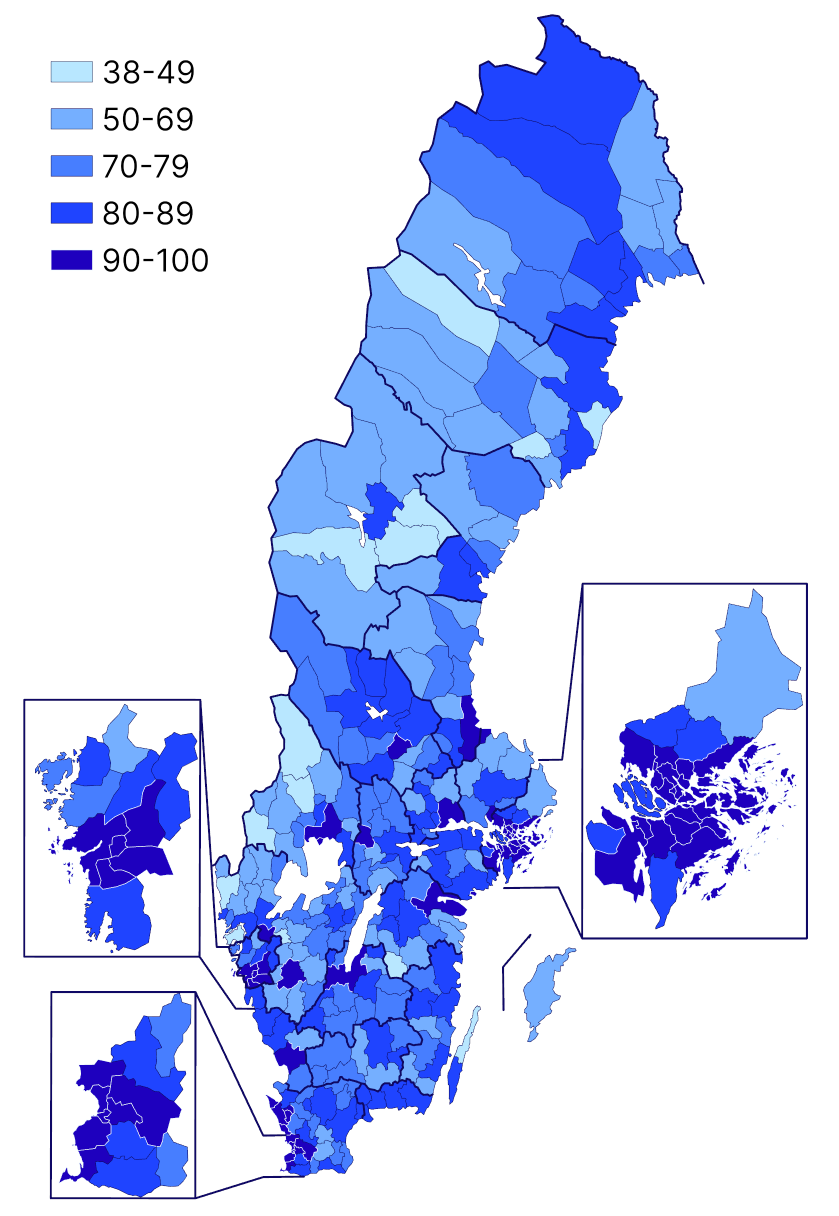
Decrease in the population of small localities
According to Statistics Sweden, a locality has at least 200 registered inhabitants, while a small locality has between 50 and 199 inhabitants. Sweden had more than 3,000 small localities in 2025, with a combined population of 271,000 persons. Between 2023 and 2025, the population of small localities decreased by almost 3,000 persons.
Areas outside localities and small localities had a population of just over 1 million at the end of 2025. This is almost 6,000 persons fewer than in 2023.
Fewer localities and small localities in 2025
In 2025, Sweden had 2,009 localities according to Statistics Sweden’s definition of statistical localities. This is 8 fewer localities than reported in the 2023 statistics, as a result of both the registration of new localities and the deregistration of existing ones. Of the new localities, 30 had been classified as small localities in 2023, while 2 had previously formed parts of larger localities. Of the 40 localities deregistered in 2025, 25 became small localities and the remaining 15 merged with neighbouring localities.
The number of small localities in 2025 was 3,058, which was 39 fewer than in 2023. A total of 257 small localities were deregistered, most due to population decrease. Just over 70 areas were classified as localities in the 2025 statistics, either because they had merged with neighbouring localities or because they formed new localities of their own. The number of newly registered small localities amounted to 218. Of these, 94 had not previously appeared in the statistics. The remaining 124 areas had appeared in the statistics in 2023 or earlier, either as small localities or localities.
Key figures for urban areas (localities) and small localities, 2025
Type of area |
Number of areas |
Population |
Share (%) of total population |
Share (%) of total land area |
Urban areas (localities) |
2 009 |
9 328 428 |
88 |
1.6 |
Small localities |
3 058 |
271 005 |
3 |
0.3 |
Outside urban areas (localitites) and small localities |
|
1 006 096 |
9 |
98.1 |
Sweden, total |
|
10 605 529 |
100 |
100.0 |
Definitions and explanations
A statistical locality is a densely built-up area with at least 200 registered inhabitants. A statistical small locality is a densely built-up area with 50 to 199 registered inhabitants. In the statistics, the term urban area is used when describing the population living in localities as a whole, for example in measures of urbanisation, population change and the degree of urbanisation. The term locality refers to an individual built-up area or to localities as statistical units.
The terms statistical locality and statistical small locality are used to indicate that the statistics are based on a classification of areas derived from register data, geospatial data and statistics. Statistics Sweden’s localities and small localities may therefore differ from how other parts of society define and delimit localities in Sweden.
Statistics Sweden delineates the areas geographically and then compiles statistics for them. The density of development is measured using geospatial data from the Swedish Mapping, Cadastral and Land Registration Authority (Lantmäteriet), based on information on buildings, properties, roads and land use. The maximum permitted distance between buildings depends on several factors, including the number of registered inhabitants and employees in different parts of the area. Information on population and employees is obtained from Statistics Sweden’s registers and combined with address data.
The boundaries of Statistics Sweden’s statistical localities and small localities are updated every five years. From 2018 onwards for localities (and from 2023 onwards for small localities), an additional update is also carried out midway through the five-year cycle. The latest edition is based on data from 2025. The next update will refer to 2028, with publication preliminary planned for autumn 2029.
Statistics on the population of urban areas are published annually. The statistics are based on annual population data from Statistics Sweden’s Population Register, combined with Statistics Sweden’s delineations of localities carried out every five years, every three years or every second year, starting with the 2000 edition. The annual population statistics for urban areas are therefore based on locality boundaries that remain in effect for several years. Together with information on the land area of the localities, the annual population figures provide a measure of population density and indicate whether urban areas are becoming more densely or more sparsely populated.
Maps and geospatial data
Open geospatial data for localities: Localities
Open geospatial data for small localities: Small localities
Statistics Sweden’s map service for regional divisions: SCB Regina Web Map
Comments
The quality of the statistics varies considerably over the period shown in the chart, depending on data availability and the definitions applied to urban areas. Until the mid-1960s, the extent of cities often coincided with municipal boundaries. In 1960, the definition of urban areas that is still used today was introduced, based on a minimum population of 200 inhabitants per locality. However, the methods used to measure the extent of localities have developed substantially since then. Two major methodological changes affected the statistics for 1990 and 2015, while minor improvements have been made throughout the entire time series.