Construction Cost Index for buildings, October 2026
Construction Cost Index rose by 0.6 percent in October 2026
Statistical news from Statistics Sweden 2026-11-16 8.00
The Construction Cost Index for multi-dwelling buildings increased by 0.6 percent in October compared with September 2026 (increased 0.1 percent in September 2026). The annual rate of change in the Construction Cost index was 4.8 percent in October, compared with the corresponding month in 2025 (3.9 percent in September 2026).
"The annual rate of change in October 2026 for Construction cost index was the highest since December 2023", says Emma Lindgren, price statistician at Statistics Sweden.
In brief
- The costs of transport increased by 2.1 percent in October 2026 compared with September 2026 and were 11.2 percent higher than in October 2025.
- The cost of diesel oil increased by 5.4 percent in October 2026 compared with September 2026 and was 42.5 percent higher than in October 2025.
- The cost of electricity increased by 0.6 percent in October compared with September 2026 and was 4.7 percent higher than in October 2025.
- Interest costs increased by 1.0 percent in October compared with September 2026 and were 8.3 percent higher than October 2025.
Construction Cost Index for multi-dwelling buildings, excl. wage drift and value-added tax
| Index | Change in percent | ||
|---|---|---|---|
| October | September 2026– October 2026 | October 2025– October 2026 | |
| Contractors' costs (82%) | 152.7 | 0.6 | 4.7 |
| Construction clients' costs (18%) | 178.6 | 0.6 | 5.2 |
| Total Construction cost index (100%) | 157.3 | 0.6 | 4.8 |
Changes in the last month
The Construction Cost Index for multi-dwelling buildings increased by 0.6 percent between September and October 2026. Both the contractors’ costs and the construction clients’ cost rose by 0.6 percent. These two groups account for 82 percent and 18 percent, respectively, of the Construction Cost Index.
Costs in the group ‘transport, fuel and electricity’ increased by 2.2 percent. Within that group, the cost of transports rose by 2.1 percent and the cost of diesel oil by 5.4 percent. The cost of electricity also rose, by 0.6 percent. Contractors’ overhead costs rose by 0.3 percent. Costs of machinery and costs for ‘wages and salaries’ were unchanged between September and October 2026.
Contractors’ costs for building materials increased by 0.9 percent in October 2026. Among the building material groups, the cost of woodwork rose the most, by 2.9 percent, followed by iron and steel products (including reinforcement steel) which rose by 1.6 percent. The only building material that fell in price compared to September 2026 were the costs of concreate products, which fell by 0.2 percent. The costs of the remaining building materials increased by up to 1.0 percent between September and October 2026
Construction clients’ costs increased by 0.6 percent in October 2026. These costs consist of interest and credit costs, planning costs, and central administration costs. The increase was mainly due to higher interest and credit costs, which rose by 1.0 percent.
Changes in the last year
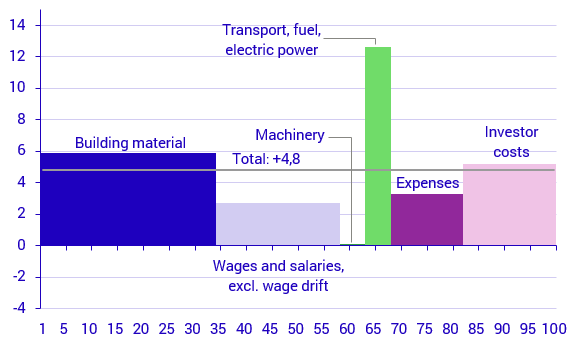
The Construction Cost Index for multi-dwelling buildings increased by 4.8 percent between October 2025 and October 2026. Contractors’ costs rose by 4.7 percent, which led to an upward contribution to the Construction Cost Index of 3.7 percentage points. Construction clients’ costs increased by 5.2 percent.
Contractors’ costs for ‘wages and salaries’ and overhead costs both increased, by 2.7 percent and 3.3 percent, respectively. Costs for machinery increased with 0.1 percent between October 2025 and October 2026. The costs for ‘transport, fuel and electricity’ increased by 12.6 percent compared to October 2025. Within this group the costs of diesel oil increased by 42.5 percent, while the cost of transport and electricity increased by 11.2 and 4.7 percent respectively.
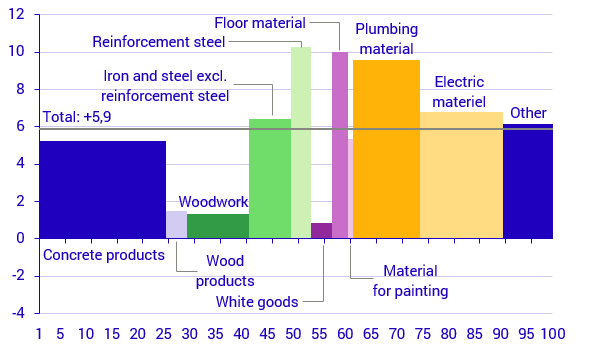
Contractors’ costs for building materials increased by 5.9 percent between October 2025 and October 2026. Among the building material groups, the costs of reinforcement steel rose the most, by 10.3 percent. Subsequently, floor material and plumbing material increased by 10.0 and 9.6 percent, respectively. All other material groups increased by up to 8.0 percent. No building materials had falling costs in October 2026 compared to October 2025.
Construction clients’ costs increased by 5.2 percent. Among the construction clients’ costs, the costs for official employee wages, according to collective agreements increased by 3.7 percent, while the costs for interests increased by 8.3 percent. The remaining costs rose by between 3.0 and 2.6 percent.
Developments in various production factors October 2025–October 2026
Changes by product type, October 2026
| Goods | Change in percent | |
|---|---|---|
| September 2026– October 2026 |
October 2025– October 2026 |
|
| Concrete products | -0.2 | 5.2 |
| Wood products | 0.9 | 1.5 |
| Woodwork | 2.9 | 1.3 |
| Iron and steel* | 1.6 | 8.0 |
| Reinforcement steel | 1.3 | 10.3 |
| White goods | 0.0 | 0.9 |
| Floor material | 0.2 | 10.0 |
| Material for painting | 0.3 | 5.3 |
| Plumbing material | 1.0 | 9.6 |
| Electric material | 0.6 | 6.8 |
| Other building materials** | 1.0 | 6.1 |
| Total building materials | 0.9 | 5.9 |
Developments in various building products October 2025–October 2026
Information about changes for 2028
CCI is currently published monthly, but from 2028 onwards it will be published quarterly. The requirements and needs of Eurostat and the National Accounts are quarterly CCI deliveries. The transition from monthly to quarterly production therefore aligns the statistics with both European and national user requirements. A change to quarterly data collection and production is also expected to reduce the response burden on data providers.
From 2028, 2025 will be the new base year for CCI, and the index will be published only including wage drift.
More information can be found here.
Changes for users retrieving data via the API
In the autumn of 2025, PxWebApi v1 was replaced by the new PxWebApi v2. PxWebApi v1 will remain operational until the turn of the year 2026/2027, after which it will no longer be available. For further information and guidance on the transition, see: