

Formally protected forest land, voluntary set-asides, consideration patches and unproductive forest land 2024
Large increase in voluntary set-asides in 2024
Statistical news from Statistics Sweden 2025-06-26 8.00
By the end of 2024, the total area of voluntarily set-asides had nearly equalled that of formally protected areas on productive forest land. Regionally, formally protected forest land covered the largest area in Northern Norrland. But in other parts of Sweden, the areas of voluntarily set-asides were larger. During 2024, voluntarily set-asides increased more than the area of formally protected forest land.
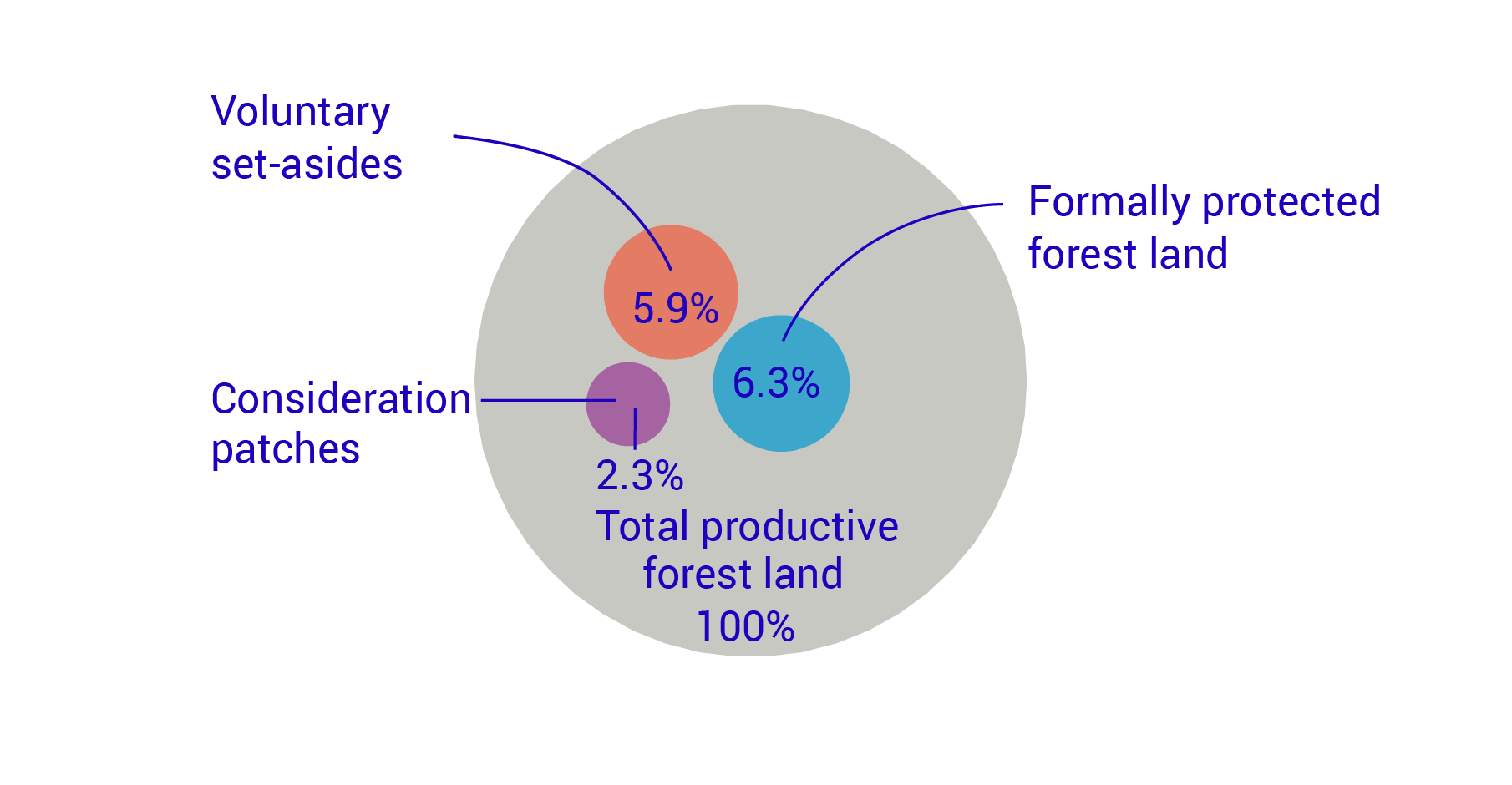
Formal protection on productive forest land amounted to a total of 1.44 million hectares in 2024. Out of Sweden's total area of productive forest land, 6.3 percent was formally protected. Voluntary set-asides amounted to 1.39 million hectares, which corresponds to 5.9 percent of Sweden’s total area of productive forest land. A preliminary estimate of consideration patches for regeneration felling amounted to an area of 550 000 hectares in 2024, which corresponds to 2.3 percent of Sweden’s total area of productive forest land.
Source: Statistics Sweden, the Swedish Environmental Protection Agency, the Swedish Forest Agency, and the Swedish University of Agricultural Sciences National Forest Inventory.
Proportions of total forest land
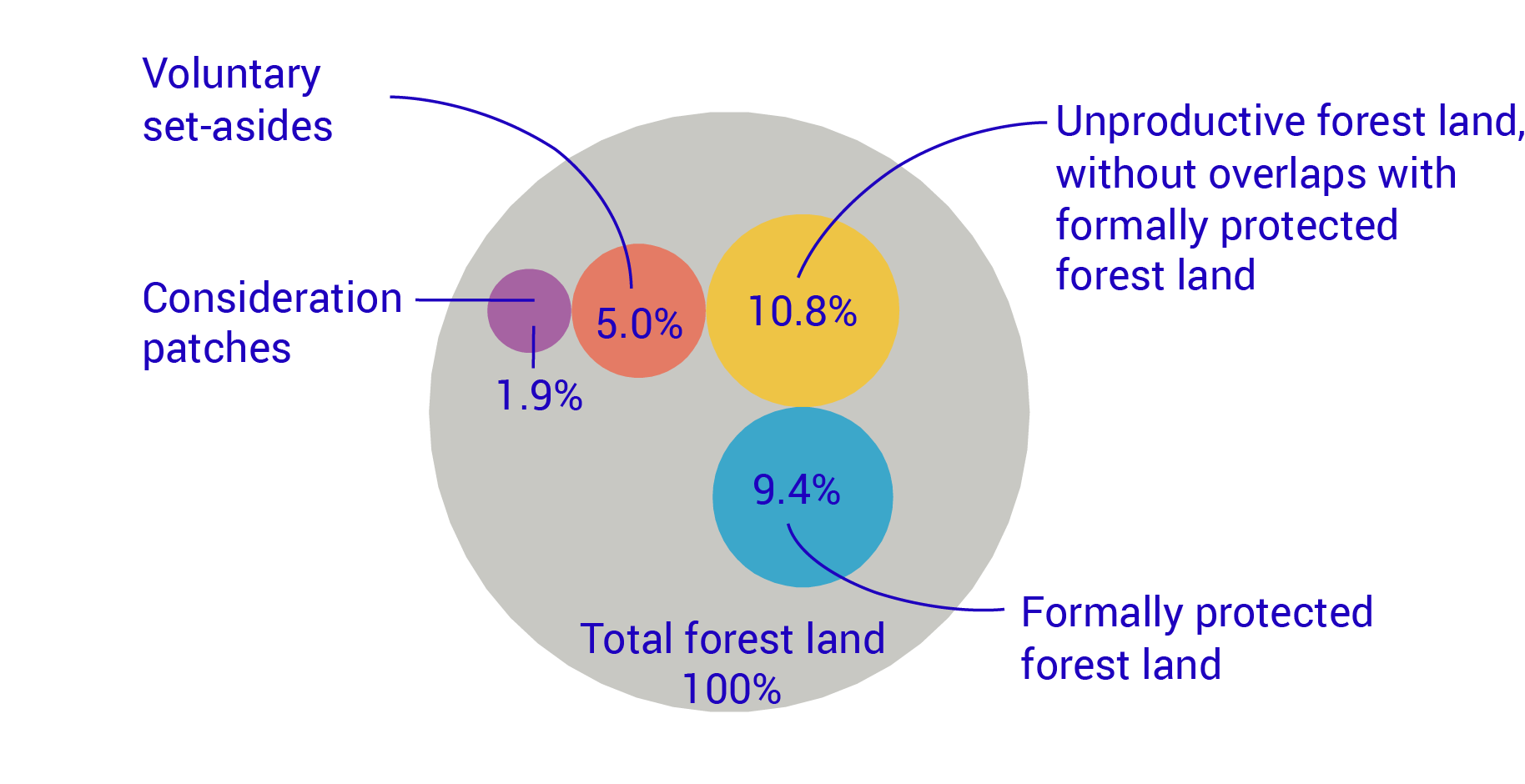
Out of Sweden's total area of forest land, including both productive and unproductive forest land, more than 9 percent was formally protected by the end of 2024. Voluntary set-asides accounted for 5 percent and consideration patches for just under 2 percent. Unproductive forest land without formal protection, amounted to almost 11 percent of Sweden's total forest land area.
Source: Statistics Sweden, the Swedish Environmental Protection Agency, the Swedish Forest Agency, and the Swedish University of Agricultural Sciences National Forest Inventory.
Formal protection largest in Northern Norrland
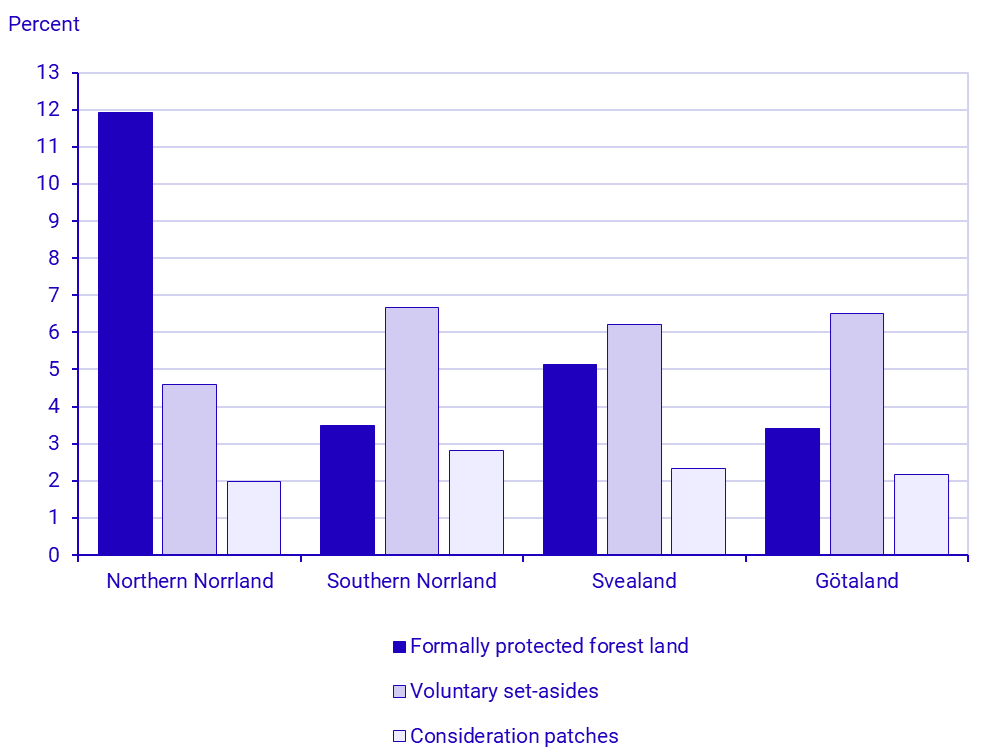
Compared to voluntary set-asides in Northern Norrland 2024, the formally protected forest land covered a significantly larger area. Out of the total productive forest land area in Northern Norrland, 12 percent was formally protected, while voluntary set-asides accounted for 5 percent of the region’s productive forest land.
In the other three regions, the areas of voluntarily set-asides were larger than the areas of formally protected and productive forest land. In Southern Norrland and in Götaland, more than 3 percent of the productive forest land was formally protected, while in Svealand the share was 5 percent. The voluntarily set-asides amounted to 7 percent in Southern Norrland and in Götaland respectively, and 6 percent in Svealand.
Source: Statistics Sweden, the Swedish Environmental Protection Agency, the Swedish Forest Agency, and the Swedish University of Agricultural Sciences National Forest Inventory
Voluntary set-asides increased the most
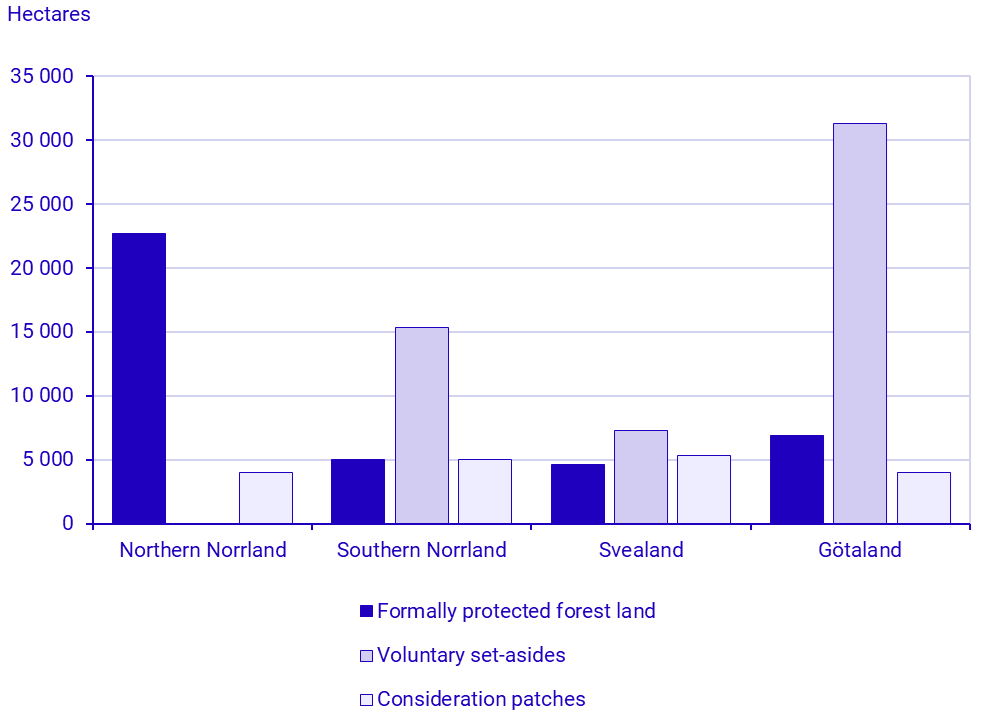
In 2024, the formally protected and productive forest land increased with 39 000 hectares. This increase corresponds to 0.2 percent of Sweden’s total area of productive forest land. Close to 60 percent of these 39 000 hectares were located in Northern Norrland. Between 2020 and 2024, the area of formally protected forest land increased by nearly 180 000 hectares in total, including formally protected unproductive forest land. This corresponds to an average annual increase of approximately 36 000 hectares over the past five-year period.
The area of voluntary set-asides is estimated to have increased by nearly 54 000 hectares in 2024, corresponding to 0.2 percent of Sweden’s total area of productive forest land. A larger share of these 54 000 hectares were located in Götaland. In Northern Norrland, no new voluntary set-aside areas were added in 2024. Between 2020 and 2024, the area of voluntary set-asides increased with a total of 123 000 hectares, resulting in an average annual increase of 25 000 hectares over this five-year period.
The consideration patches increased with an estimated area of 18 000 hectares in 2024, evenly distributed across the four parts of Sweden. This corresponds to 0.1 percent of Sweden’s total area of productive forest land. The average annual increase of consideration patches over the past five-year period is estimated to approximately 20 000 hectares.
Source: Statistics Sweden, the Swedish Environmental Protection Agency, the Swedish Forest Agency, and the Swedish University of Agricultural Sciences National Forest Inventory
Definitions and explanations
Forest land
Under the Forestry Act (1979:429), forest land is defined as a coherent area in which trees are higher than five metres and the crown cover is more than ten percent or there are conditions to attain this height and crown cover without production-enhancing measures. This definition has been valid since 2008 when it was changed (SFS 2008:662) in order to harmonize the Swedish definition of forest land with the international one. The area of forest land in Sweden became larger according to the new definition compared to the old one (Loman, 2011).
Productive forest land
Under the Forestry Act, productive forest land is defined as forest land that, according to generally accepted criteria, can produce on average of at least one cubic metre of wood per hectare and year.
Types of forest land
Statistics Sweden presents statistics on four different types of forest land:
- Formally protected forest land
- Voluntary set-asides
- Consideration patches for regeneration felling
- Unproductive forest land
They are described in the government assignment (N2018/04159/SK) as the subsets on which these statistics are to be distributed. The statistics are produced in a collaboration between Statistics Sweden, the Swedish Environmental Protection Agency, the Swedish Forest Agency, and the Swedish University of Agricultural Sciences.
There is a lack of data to assess the consistency of voluntary set-asides and consideration patches. This leads to a certain degree of uncertainty in the statistics.
Formally protected forest land
Forest land regulated by laws and ordinances concerning protected areas, as well as agreements, entered into individual decisions. In these statistics, it is a collective term for various forms of protection. These are present in both productive and on unproductive forest land. The protection included in the statistics are:
- National parks
- Nature reserves with regulations against forestry
- Habitat protection areas
- Natura 2000 SCI with designated forest habitats
- Nature conservation agreements, including “ekoparker” and the White-Backed Woodpecker Action Plan
- Agreement between government agencies between the Swedish Environmental Protection Agency and the Swedish Fortifications Agency
- Habitat protection areas and nature reserves for which the decision is not final and binding
- Land compensation for the establishment of national parks and nature reserves
Voluntary set-asides
Areas of productive forest land on which landowners voluntarily decided not to carry out any measures that can harm natural values, cultural environments, or social values.
Consideration patches
Small areas of productive forest land that have been made available, voluntarily, or pursuant to the Swedish Forest Care Act, for regeneration felling. The areas are preliminary estimates based on the most recent definitive five-year average value in 2019/2020.
Unproductive forest land
Forest land that, according to generally accepted criteria, is not able to produce on average at least one cubic metre of wood per hectare and year. Examples of unproductive forest land include subalpine birch forests, tree- or shrub-covered mires, and sparsely wooded rocky land areas.
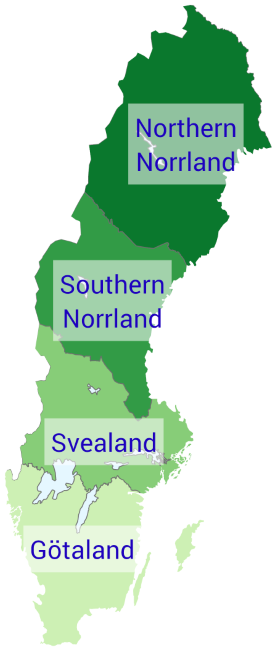
Four parts of Sweden
A division of Sweden into four regions, aligned with county boundaries. From north to south, they are: Northern Norrland, Southern Norrland, Svealand, and Götaland.
Four parts of Sweden – Northern Norrland, Southern Norrland, Svealand, Götaland
Source: Statistics Sweden
Average annual increase
The average annual increase in total area between 2020 and 2024 has been calculated using the following formula:
Average annual increase = (A2024 - A2019) /5
Where:
- A2024 is the total area in 2024
- A2019 is the total area in 2019
- The numerator represents the total increase over the period
- The denominator (5) corresponds to the number of years between 2020 and 2024
The areas of formal protection include both productive and unproductive forest land. In contrast, the areas of voluntary set-asides and consideration areas refer exclusively to productive forest land, as these forms, by definition, cannot occur on unproductive forest land.
Revisions
Refers to changes in previously published data due to quality improvements. Statistics on consideration patches and unproductive forest land have been revised for the most recent reporting years. Correct and updated figures for all years are available in Statistics Sweden’s statistical database.
Publication
A more detailed report of this survey is published in the Statistical Report:
Next publishing will be
The next statistical news in this series will be published in 2026.
Statistical Database
More information is available in the Statistical Database
Feel free to use the facts from this statistical news but remember to state Source: Statistics Sweden.