

Labour Force Surveys (LFS) 2025:1 - Theme: Work from home and hours worked
Many people in Sweden still work from home
Statistical news from Statistics Sweden 2025-03-25 8.00
The share of people who still work from home remains at a significantly higher level in 2024 in comparison to the years before the pandemic. A new report from Statistics Sweden’s Labour Force Surveys (LFS) shows how working from home among permanent employees 20–64 years in Sweden has changed over time and their hours worked.
– The share of people who often work from home is, after some decrease, still at a high level. We also see an overall higher level of total hours worked among those who work from home, says Stefan Andersson, statistician at the Labour Force Surveys at Statistics Sweden.
How much do we work from home?
In 2024, the share of employed people aged 20–64 who to some extent stated that they worked from home amounted to about 46 percent. This is an increase of about 26 percentage points since 2008. The largest increase is found among those who work from home at least half of the days. Before the pandemic, around 6 percent of employed people worked from home at least half of their working days. Along with the pandemic, the share almost quadrupled and in 2024 it was about 13 percent. After the pandemic, the share of people who often work from home has decreased, although at a slower pace. Between 2023 and 2024, the share decreased by just under 1 percentage point. Before that, between the years 2008 and 2019, the share of people who worked from home at least half of the days has been at a relatively steady level with a slightly increasing trend. However, the opportunity to work from home for a larger part of the working day has previously been limited to the self-employed and certain specific occupational groups.
In 2024, it was most common among permanent employees aged 30–54 years to work at least half of the days from home. Since 2019, the share for this age group has increased from about 4 percent for women and 5 percent for men to 14 per cent for each group.
There are also large differences between employees with different levels of education and between different sectors. Working from home is most common and has increased the most among people with post-secondary education and who work within either the private service sector or the state sector. Among these persons, the share who work from home at least half of their working days has increased from 10 to 22, and from 12 to 21 percent, respectively. The opposite is observed for the municipal sector, where the corresponding share has instead decreased between 2019 and 2024, from 7 to 5 percent. The fact that fewer people work from home within the county council and municipal sectors can be explained by the composition of professions, where work tasks require physical meetings to a greater extent.
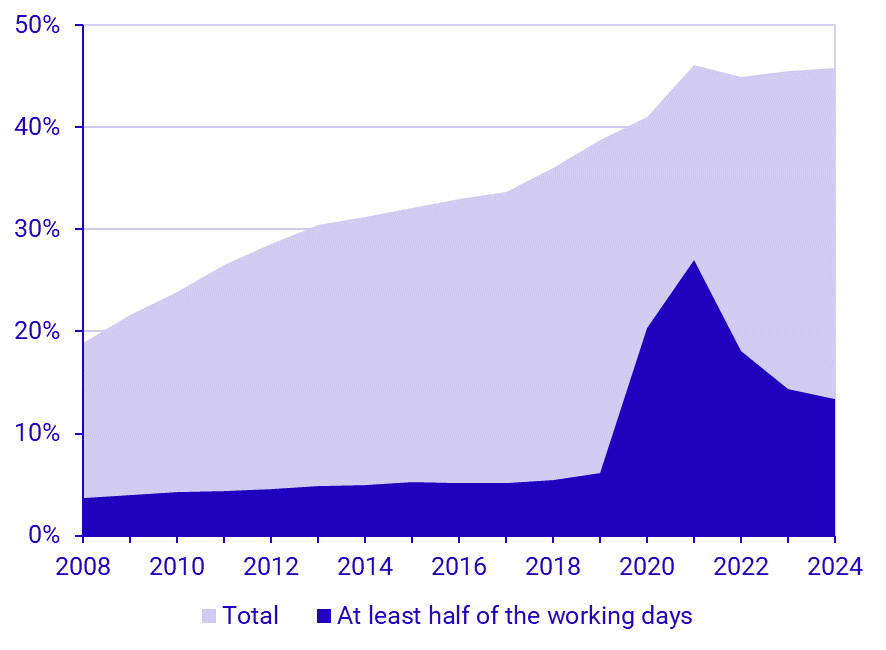
Source: Labour Force Survey.
The increased extent of working from home is also very much a metropolitan phenomenon, although working from home has also increased outside the larger cities. Before the pandemic, the share of people who worked from home was relatively evenly distributed across metropolitan, urban and rural areas. On the other hand, the share who often work from home has increased to just over 15 percent in the metropolitan areas, compared to about 10 percent in urban and rural areas.
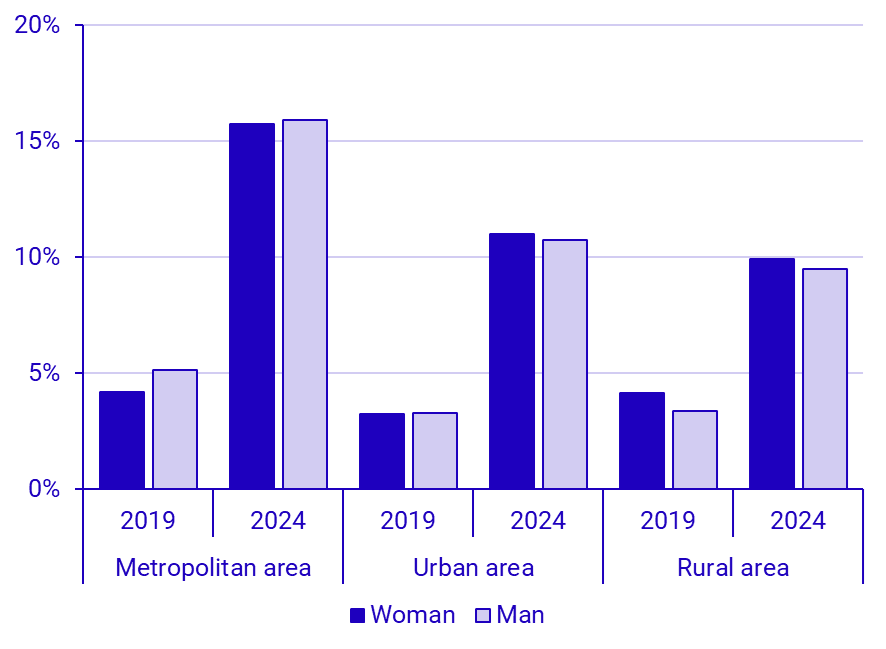
Source: Labour Force Survey.
How do hours worked differ among those who work from home?
Working remotely from home frees up time that is otherwise spent commuting to and from the workplace, among other things. This time can either be spent on leisure or in some cases more hours worked. In general in all reporting groups, the results show that the usual hours worked per week are higher among people who work from home. The difference between those who work from home and those who do not is about the same in most reporting groups in the report. Between sectors, the difference is most pronounced for people who work in county council or municipal sectors. In these sectors, hours worked are almost 3 hours higher among those who work from home. A result in the opposite direction is observed in IT professions where working from home is most widespread. In these professions, those who work from home instead tend to work about an hour less.
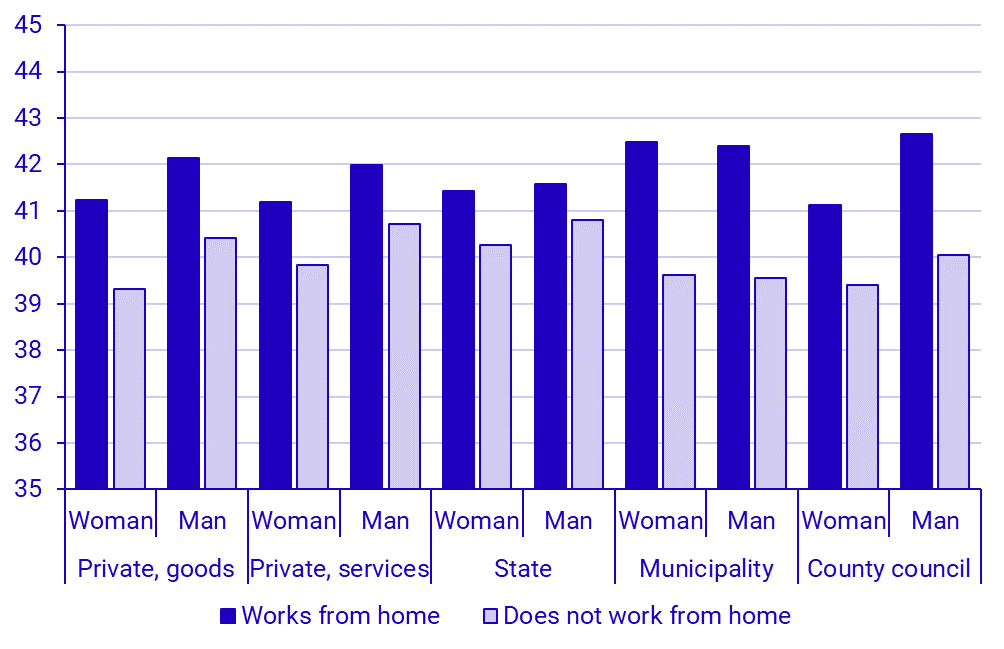
Source: Labour Force Survey.
A regression model has been used to investigate the relationship between working from home and time worked, where time worked is explained by working from home and other background factors. The results show that there is an overall positive correlation between working from home and regular working time, at both individual and professional level. The average marginal effect of working from home in the model varies from 0.5–1.5 hours per week between different reporting groups. Working from home is to a greater extent linked to more hours worked in the younger and older age groups, among people without post-secondary education and in rural areas compared to in the metropolitan areas. However, there is a significant variation between occupational categories. In some qualified professions, such as managers and teachers, working from home is linked to 2–4 more hours worked per week. In the IT professions where the extent of working from home is the greatest, on the contrary, remote work from home is linked to slightly fewer hours worked.
Facts: About the statistics
The report is based on annual data from the Labour Force Surveys (LFS). The Labour Force Surveys is a sample survey that describes the development of the labour market for Sweden's population, aged 15–74 years. This report is limited to permanent employees aged 20–64.
Publication
A more detailed report on the labour market situation is available in the publication Work from home and hours worked
Feel free to use the facts from this statistical news but remember to state Source: Statistics Sweden.