
Financial Accounts third quarter 2025
Households borrowed more in the third quarter
Statistical news from Statistics Sweden 2025-12-18 8.00
In the third quarter of 2025, household liquid savings amounted to SEK 30 billion, which was an increase from SEK 17 billion in the corresponding quarter of 2024. Over the period under review, household annual loan growth rate has continued to increase.
- During the third quarter of the year, households increased their savings in liquid assets by SEK 13 billion compared with the third quarter of 2024. Purchases in mutual fund units and listed shares were the main reason for the increase. While savings are on the rise, households have simultaneously increased their loans, says Camilla Gylfe, economist at Statistics Sweden.
Household liquid savings, i.e. their net transactions in financial liquid assets minus net borrowing, amounted to SEK 30 billion in the third quarter of the year, which is SEK 13 billion higher than in the corresponding quarter last year.
In the third quarter of 2025, Swedish households net purchased fund units to a value of SEK 27 billion, which is an increase of SEK 15 billion compared with the corresponding quarter last year. They also increased their net purchases of listed shares, which amounted to SEK 5 billion, an increase of SEK 7 billion compared to the third quarter of 2024. At the same time, households made net withdrawals from bank accounts to a value of SEK 5 billion, which contributed to a reduction in liquid savings.
Household liquid savings, components and total, SEK billion

Household net borrowing
Swedish household net borrowing, i.e. the sum of new loans minus amortisation, amounted to SEK 40 billion in the third quarter of 2025. This represents an increase of SEK 19 billion compared with the corresponding quarter last year. The annual growth rate of household loans rose to 2.5 per cent in the quarter, compared with 2.2 per cent in the previous quarter.
- Despite the fact that households have borrowed more in recent quarters, they still have a considerable distance to cover before returning to the levels observed prior to the rise in inflation and interest rates. From 2015 to 2020, households increased their loans by around SEK 60 billion per quarter, with further increases during the pandemic. In the last two quarters, we have seen households increase their loans by about SEK 40 billion per quarter, says Jonas Hallberg, economist at Statistics Sweden.
Household net borrowing, SEK million
Household savings remain high
After inflationary pressures and real wage cuts, especially in 2022 and 2023, the financial accounts showed an increase in savings from households. While real wages have shown positive growth over the last five quarters, it is difficult to see a clear trend in liquid savings.
Household liquid savings, moving average four quarters, million (left), and real wages, per cent (right)
Financing of non-financial corporations
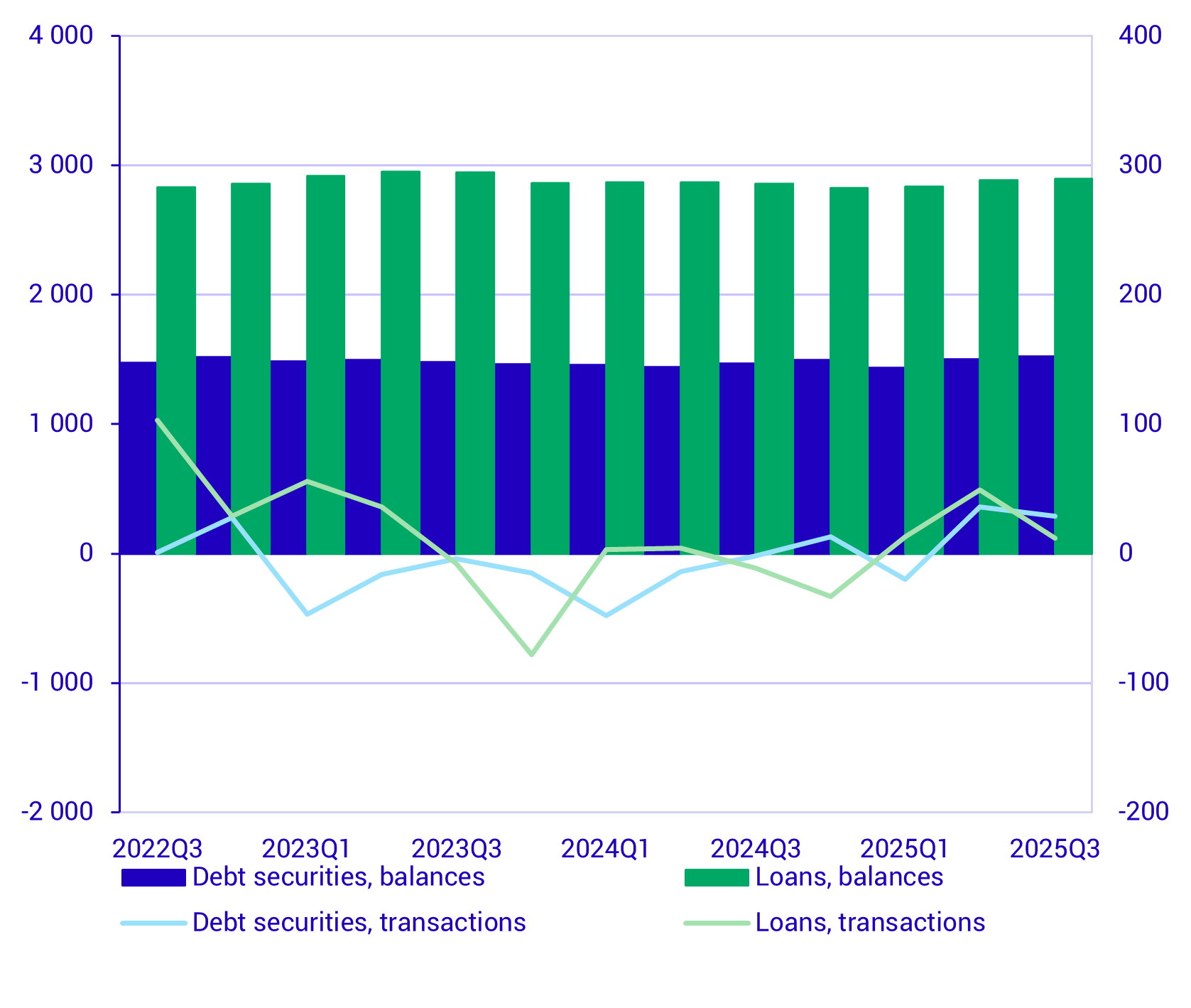
In the third quarter of 2025, non-financial corporations financed themselves with net borrowing, i.e. new loans minus amortisation, with monetary financial institutions to a value of SEK 12 billion. In the previous year, the value of the corresponding quarter was SEK -11 billion, which means that the companies then amortized more than they borrowed.
Financing through debt securities, new issues minus maturities and repurchases, amounted to SEK 19 billion in the third quarter of 2025. In the corresponding quarter of the previous year, they reduced their debtsecurities debt by SEK 2 billion.
Total loans from MFIs amounted to SEK 2,898 billion at the end of the quarter. The value of issued debt securities amounted to SEK 1,524 billion.
Non-financial corporations' financing via debt securities and loans, transactions and position values, SEK billion
Revisions
In the publication of the financial accounts for the third quarter of 2025, revisions have been made back to 2019 in order to improve the statistics where new data have become available. The revisions affect both the time series for years and quarters.
The government's repurchase agreements and long-term loans have been revised back to 2019 as a result of previous incorrect instrument classification.
The central government's tax accruals for households and companies have been revised with new data from the Swedish National Financial Management Authority (ESV) from 2024.
The foreign sector has been revised back to 2019 with new data from the Balance of Payments, where the outcome of the annual survey for direct investments has resulted in revisions in financial transactions andbalances.
Data for debt securities issued have been revised back to 2019, with major revisions for banks and housing institutions in particular. Fixed income securities issued for investment funds have been implemented in financial accounts for the first time.
Definitions and explanations
In the statistical news, reference is made to the liquid financial savings of households. It is calculated as the difference between transactions in financial assets and liabilities excluding accruals (tax accruals, occupational pensions and other technical provisions). For more information, see the Financial Accounts Quality Declaration, section 1.2.2.
The aim of financial accounts is to provide information on financial assets and liabilities as well as changes in financial savings and financial wealth for different sectors of society. The statistics are presented in current prices and do not take inflation into account.
The financial savings in financial accounts is calculated as the difference between transactions in financial assets and liabilities. In the Real Sector Accounts, which, like the Financial Accounts, are part of the National Accounts, financial savings are calculated as the difference between income and expenses. However, financial accounts and real sector accounts are based on different sources, which gives rise to differences between these two products.
In the Financial Accounts, the government debt is calculated differently from the government debt metric that is most frequently reported and which is calculated according to the convergence criteria – the ‘Maastricht debt’. The definition of the Maastricht debt does not include all financial instruments, the instruments are presented in nominal value and the liabilities for government administration are consolidated. The government debt in the Financial Accounts is unconsolidated and includes all financial instruments at market value.
In addition to the government agencies, the government administration sector also includes certain state foundations and state-owned companies. Government administration does not include entities within the retirement pension system. Instead, they make up the social security funds sector. Municipal administration includes primary municipal authorities, regional authorities (formerly county council authorities), municipal associations and certain municipal foundations and certain municipally or regionally owned companies.
More information: National wealth
The National Wealth, which contains annual data on non-financial and financial assets, is also published in connection with the publication of the Financial Accounts. Financial assets and liabilities are collected from the Financial Accounts and are thus consistent with the values published in the Financial Accounts.
For further information, see: