
2025
Use of AI growing in both the enterprise sector and among the population
Statistical news from Statistics Sweden 2026-05-21 8.00
The use of AI in Swedish enterprises has continued to increase and was most widespread among large enterprises. At the same time, generative AI tools have become more common among the population, with private use being the most prevalent. It was also more common for enterprises with a balanced gender distribution to use AI. On an international comparison Swedish enterprises ranked highly, both AI usage and the in-house development of AI solutions.
The use of AI among Swedish enterprises has increased rapidly in recent years. In 2025, 35 percent of enterprises in Sweden used AI, which was an increase of 10 percentage points compared to 2024. Large enterprises (250 or more employees) had the highest level of AI usage during the year, which has been the case since measurements began in 2021.
“The results show that large enterprises to a greater extent use AI compared to small enterprises. Larger enterprises also have more resources—such as the use of cloud computing services for development and operations, personnel who perform data analysis, and employed ICT specialists—all of which can act to enable a wider use of the technology” - says Fredric Nyström, Statistician at Statistics Sweden
There were substantial differences in AI usage across different industries. In 2025, 89.6 percent of all enterprises in Information Technology and other communication activities (J62–63) used AI, while only 12.3 percent of enterprises in Transportation and Storage (H49–53) did so during the same period. These industries represent the highest and lowest shares of AI usage within the business sector, respectively.
The use of AI has shown a steady rate of development across size classes between 2024 and 2025

Among the Swedish population, the use of generative AI tools has increased, primarily for private purposes. In the age group 16 years and older, the share of users rose from 25 to 37 percent between 2024 and 2025. In total, 30 percent reported using generative AI for private purposes, while 18 percent had used such tools at work. A smaller share, 10 percent, used generative AI tools in formal education, for example in school or at university.
This relatively low usage of generative AI for this purpose across the overall population is partly explained by the fact that few individuals in the older age groups are studying. In the youngest cohort, 16–24 years, however, usage was almost equally common for educational and private purposes—48 and 49 percent, respectively.
Men used generative AI to a greater extent than women in 2025. Among men, 34 percent used the technology for private purposes, compared to 25 percent among women. In relation to work-related purposes, the differences were somewhat less pronounced, but men still used generative AI more for this purpose than women.
Generative AI tools have most often been used for private purposes
In order to describe the variation in enterprises’ use of AI, Statistics Sweden has developed seven AI profiles. These profiles are based on the breadth of AI use and how enterprises acquire their AI solutions. They range from enterprises that do not use AI (profile 1) to enterprises that use multiple technologies and purposes and develop their own AI systems (profile 7).
The AI usage of the large enterprises fell, to the greatest extent, within the profile with the broadest usage and in-house development of AI solutions (profile 7), while the absence of AI usage (profile 1) was the most common profile among the small enterprises (10 – 49 employees).
The breadth of AI usage was also linked to experience in using these technologies over a longer period. Among enterprises that had used AI for four years or more, 73.4 percent belonged to profile 7. The corresponding share among enterprises that had used AI for only one year was 15.9 percent.
Large enterprises have had a higher share of broader AI usage
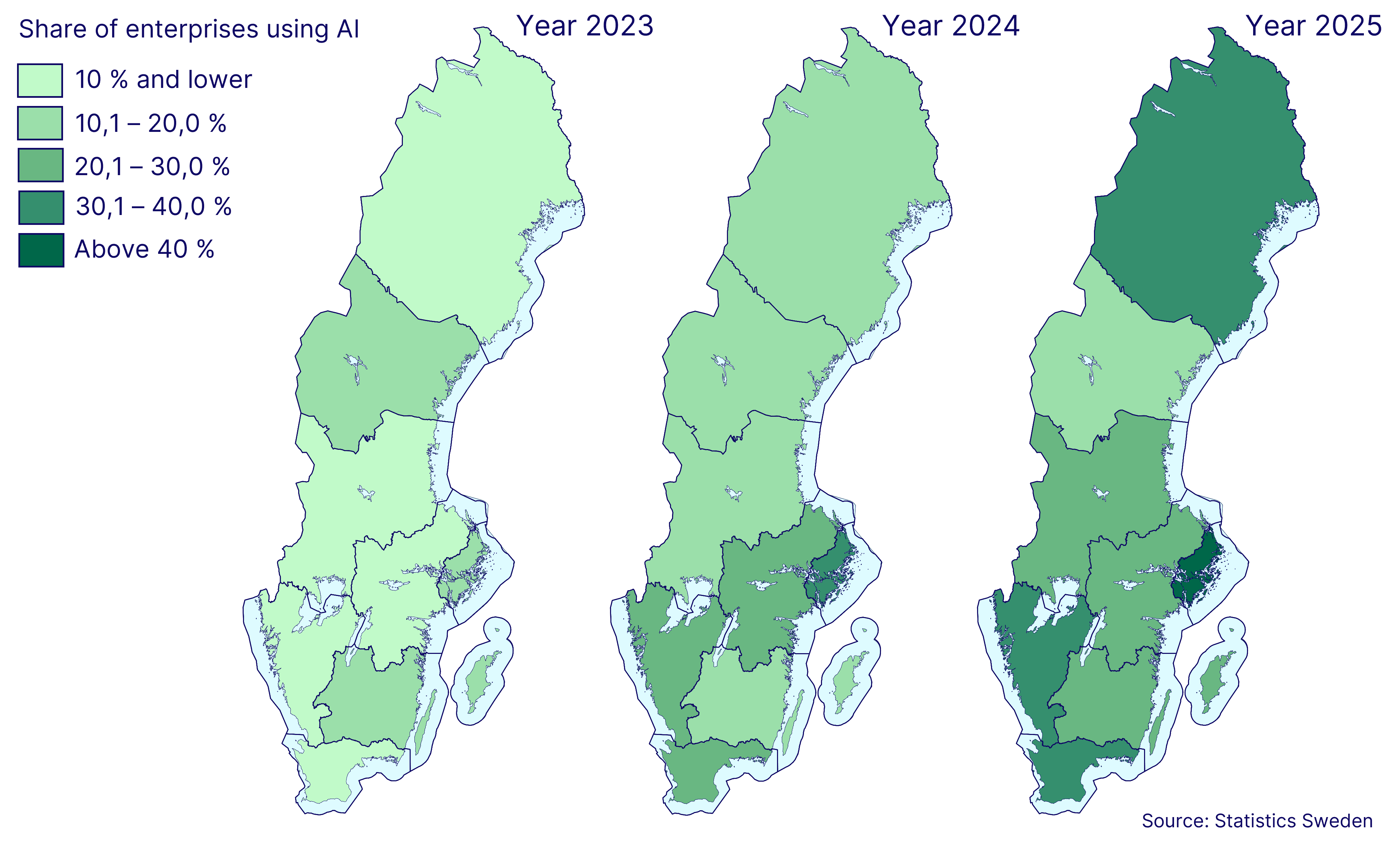
In terms of where in the country AI tended to be used, enterprises in the Stockholm region and Western Sweden were at the forefront in 2025, while Northern middle Sweden and Middel Norrland showed the lowest levels of usage. That regions such as Stockholm and Western Sweden, including Gothenburg, exhibited the highest shares of AI-using enterprises is not particularly surprising. As metropolitan regions, they are characterized by a concentration of both expertise and capital, which both are factors that facilitate the adoption of new technologies such as AI.
Stockholm has had the highest level of AI usage throughout the entire period, and the gap compared to other regions has widened over time. Småland and the islands had the second-highest share in 2023 but subsequently fell behind as usage increased more rapidly in other regions.
Enterprises in Stockholm and Western Sweden had the highest AI usage in 2025
As mentioned earlier, among the Swedish populace, it was more likely that men used generative AI at work in 2025. Among enterprises, however, the relationship was the opposite. Female dominated enterprises were more likely to have used AI than male dominated enterprises in 2024. An enterprise is defined as male or female dominated if more than 60 percent of its employees are of one gender. If the gender distribution lies between 40 and 60 percent, the enterprise is considered gender balanced. The highest share of AI-using enterprises in 2024 was found among these gender balanced enterprises.
Gender-balanced enterprises have used AI to the greatest extent
In an international comparison Nordic enterprises rank highly. Every fifth enterprise in the EU’s 27 member states used some form of AI technology in 2025, while AI-usage in the Nordic countries ranged from 28.9 percent in Norway to 42.0 percent in Denmark. Sweden was among the top five countries in terms of both in-house development of AI and the use of AI, cloud services, and data analytics.
The Nordic business sector ranks high in AI use
The report contains more detailed statistics on the topics mentioned above. It also covers areas related to AI usage for innovation and R&D, the role of employees' education in enterprises’ use of AI, and how the use of the technology differs between enterprises in rural and urban areas. You can find the report here: www.scb.se/publication/62482
Statistics on artificial intelligence are part of Sweden’s official statistics and are based on several surveys within the field of research and the digital society. The majority of the results come from the survey ICT usage in enterprises, which annually measures digitalization in the business sector. Questions on AI were introduced into the EU’s common questionnaire in 2021, enabling international comparisons. These questions were repeated in 2023, 2024, and 2025.
Data on individuals’ use of generative AI come from the survey ICT usage in households and by individuals. Statistics on research, development, and innovation are drawn from the surveys Research and Development in Sweden and Innovation in the Business Sector. Information on employee characteristics is based on The Swedish Occupational Register with statistics.
Comments