

Skills, education and work among foreign born
Skills increase with more years in Sweden
Statistical news from Statistics Sweden 2026-01-29 8.00
Coming to a new country often means starting over – with the language, with the education and with working life. The results from PIAAC 2023 show that foreign born people on average have lower literacy and numeracy skills than Swedish born people, but that the skills are clearly strengthened with more years in Sweden, higher education and establishment in the labour market.
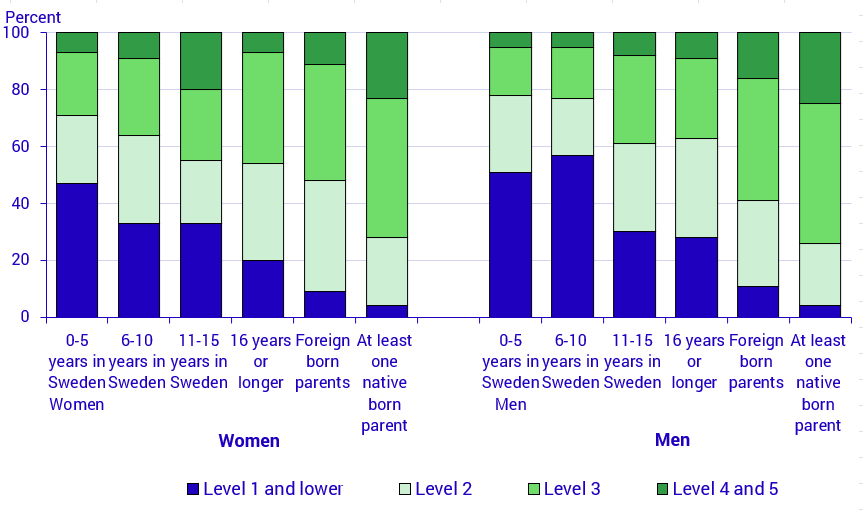
The results from PIAAC 2023 show that foreign-born people who have been in Sweden for ten years or less have both lower average results and greater variation in skills than those who have been in Sweden longer. After ten years in Sweden, the spread has decreased, and skills have increased significantly. Skills are affected not only by how long a person has lived in Sweden, but also by when in life the person arrived. Those who came to Sweden as children have on average higher skills than those who came in their teens or as adults.
The pattern in literacy skills is similar when comparing women and men. Women have a significantly lower proportion with deficient skills (level 1 and lower) compared to men among those who were born abroad and have been in Sweden between 6 and 10 years.
Population aged 16–65, 2023
Source: PIAAC 2023
Different educational backgrounds provide different conditions
Among foreign-born people, there is also a large variation in educational background — from people who have never been to school to people with higher education. These differences reflect both the quality of education and training systems in different parts of the world and the opportunities people had to participate in education before migration.
The level of development of the country of birth is an important part of the background. When countries are grouped by the Human Development Index (HDI), clear differences in skills emerge. People from countries with lower HDI levels have on average significantly lower scores in both literacy and numeracy than people from countries with higher HDIs. The differences are significant; in PIAAC 2023, there is a difference of about 80 points in average literacy scores between the highest and lowest ranked regions. This variation illustrates how the quality of education systems and access to education before migration affect the conditions for developing skills in Swedish after arrival in Sweden.
Foreign born persons study more than Swedish born persons
Foreign born persons aged 25–65 participate in formal education to a significantly greater extent than Swedish born persons. The difference is visible in all skill levels. Many begin their studies in Sweden through Swedish for Immigrants (SFI) and some then continue in adult education or college. The results indicate that many who have started SFI move on to other forms of education.
In addition to formal education, many also participate in non-formal education, often in the form of courses linked to working life. Participation is high in this type of education among both Swedish born and foreign-born persons. Together, the results show that adult education takes place in several ways and that both educational background, labour market requirements and time in Sweden affect which educational paths are relevant.
Population aged 25–65, 2023
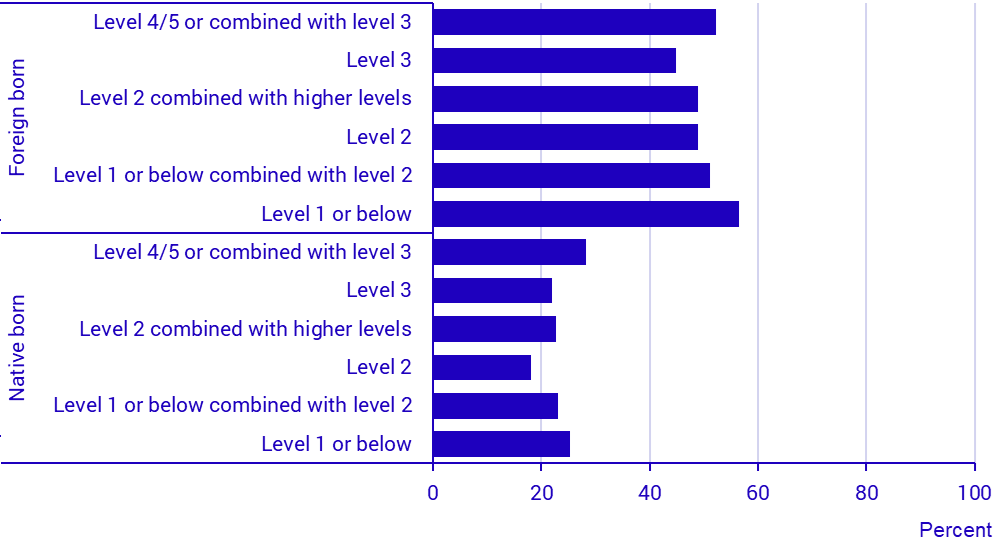
Source: PIAAC 2023. Statistics Sweden, Population study participation Skill levels are divided by proficiency levels for both reading and counting. This means that it is possible to study the participation of those with poor reading and numeracy skills (level 1 or lower) and those with good or very good reading and numeracy skills (level 3 or higher).
Fewer people working full-time among foreign-born women with inadequate skills
Among women born abroad, 54 per cent of those with poor literacy or numeracy skills usually work at least 36 hours per week. The corresponding proportion among women born abroad with good or very good skills is significantly higher, at 81 per cent. A similar pattern exists among native-born women.
There are also clear differences between foreign-born women and men with inadequate skills in terms of the proportion who work at least 36 hours a week. Men work full-time to a significantly greater extent than women in the same group. Among foreign born persons with good or very good skills, on the other hand, there are no significant differences between women and men.
For people born in Sweden, there are no differences in weekly working hours among those with inadequate skills. However, among those with good or very good skills (levels 3, 4 and 5), women are less likely to work at least 36 hours a week compared to men.
Share of employed persons with different weekly working hours, aged 25–65, 2023 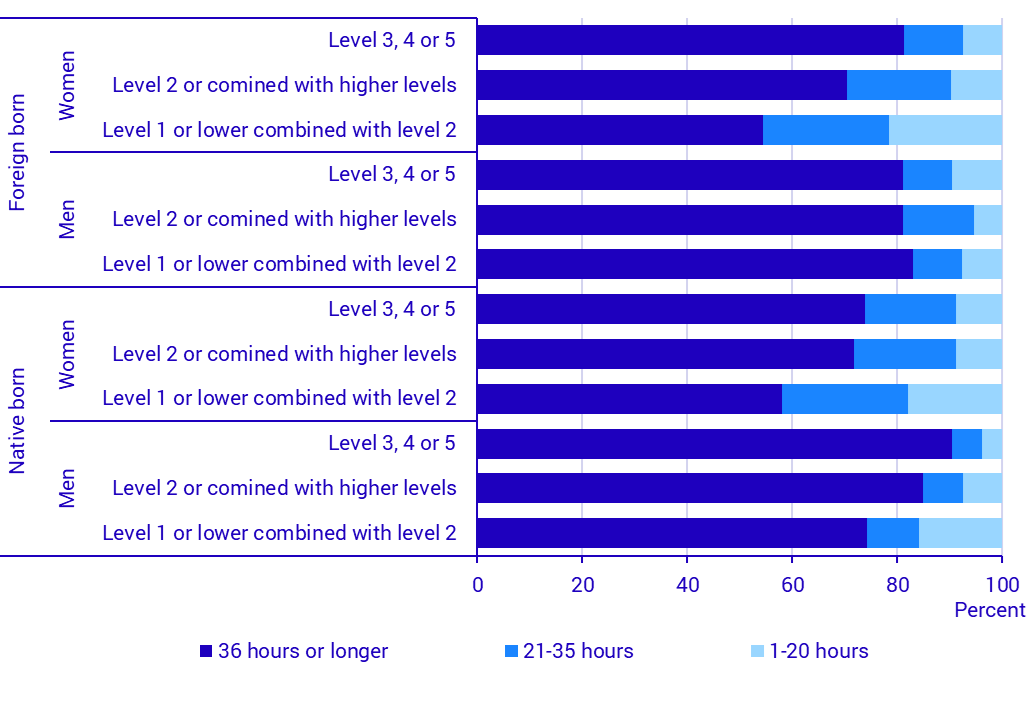
Source: PIAAC 2023 Skill levels are divided by proficiency levels for both reading and counting. This means that it is possible to study the participation of those with poor reading skills or poor numeracy skills (level 1 or lower) and those with good or very good reading and numeracy skills (level 3 or higher).
Skills are related to socio-economic conditions in the residential area
Among foreign-born people living in areas with major socio-economic challenges, about half have deficient literay skills. In areas with good socioeconomics, the corresponding proportion is significantly lower, at 26 percent. The differences in average skills between residential areas are largely due to demographic differences, especially the residents' level of education, foreign background, length of stay in Sweden and level of development in the country of birth.
Definitions and explanations
The survey assesses basic skills in literacy, numeracy and problem solving. In each area, people are awarded points on a scale of 0 to 500. The scales have been divided into different proficiency levels, defined by a fixed range of points and by the difficulty of the tasks. Six proficiency levels are defined for literacy and numeracy, and five levels for problem solving.
The survey was conducted in Swedish, which means that good knowledge of the Swedish language was essential for managing the tasks in literacy, numeracy and problem solving. Accordingly, those who do not yet have sufficient knowledge of Swedish were assessed as having a low level of skills in each area of knowledge.
Publication
A more detailed report of this survey is published in a Theme Report.
Feel free to use the facts from this statistical news but remember to state Source: Statistics Sweden.