

Financial market statistics, October 2025
The proportion of floating-rate mortgages is increasing
Statistical news from Statistics Sweden 2025-11-27 8.00
The average floating mortgage interest rate decreased in October to 2.69 percent, down from 2.80 percent in September. At the same time, the proportion of mortgages with floating interest rate increased to 74 percent. The growth rate for housing loans increased in October to 2.7 percent, compared with 2.6 percent in September.
– The proportion of floating-rate mortgages continues to increase as the average floating mortgage interest rate declines, says Olha Borgelin, statistician at Statistics Sweden (SCB).
Developments in October 2025 summarized
Lending
- The monetary financial institutions (MFI) annual growth rate of lending to households was 2.9 percent in October 2025. Housing loans accounted for 83 percent of total lending to households. The growth rate for housing loans was 2.7 percent. Consumer loans, which accounted for 6 percent of total lending to households, had an annual growth rate of 4.4 percent.
- The annual growth rate for lending to non-financial corporations was 3.0 percent in October 2025, to be compared with 2.5 percent in September 2025.
- In total, lending from MFIs to households and non-financial corporations amounted to SEK 8 126 billion. Loans to households accounted for 63 percent (SEK 5 108 billion) and loans to non-financial corporations accounted for 37 percent (SEK 3 018 billion).
- The total lending from MFIs lending to households for housing loans, outstanding agreements, was SEK 4 228 billion in October 2025. The proportion with floating interest rate was 74 percent (SEK 3 128 billion) in October.
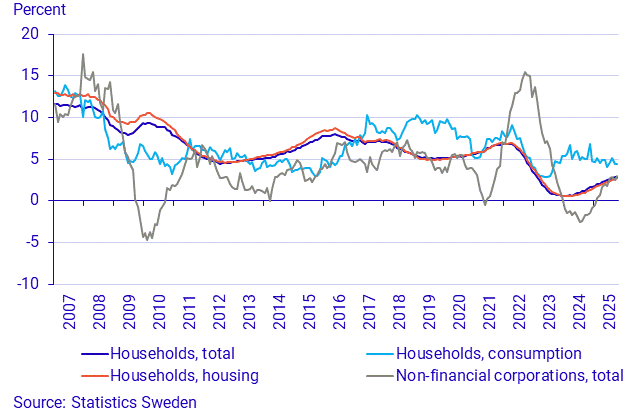
- The annual growth rate of housing loans from institutes other than MFIs on mortgage markets, known as mortgage credit companies, was noted at -3.2 percent in October 2025. Mortgage credit companies accounted for 1.0 percent (SEK 42 billion) of total housing loans to households which amount to SEK 4 270 billion.
Deposits
- In October 2025, MFIs’ total deposits from households amounted to SEK 2 853 billion. On demand deposits accounted for 75 percent (SEK 2 132 billion). It is to compare to October 2024 when on demand deposits accounted for 74 percent of total deposits to households (SEK 2 729 billion).
- Notes and coins held by Swedish non-bank public, previously defined as the money supply measurement M0, amounted to SEK 55 billion in October 2025. The money supply M3 amounted to SEK 5 035 billion and had an annual growth rate of 4.3 percent.
Interest rates on lending and deposits
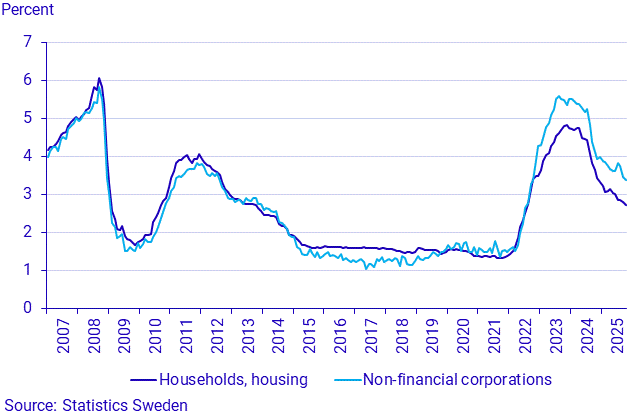
- In October 2025, the average interest rate on new agreements for housing loans to households was 2.72 percent. The average floating rate on housing loans was 2.69 percent.
- The average fixed interest rate between 1 and 5 years on new agreements for housing loans to households was 2.89 percent in October 2025.
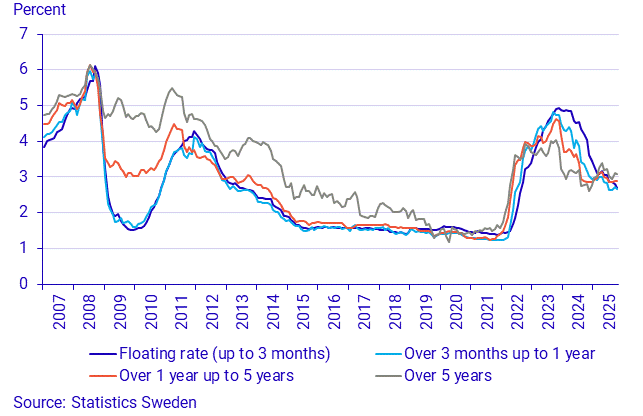
- In October 2025, the average interest rate on new agreements for lending to non-financial corporations was 3.36 percent, to be compared with 4.11 percent in October 2024.
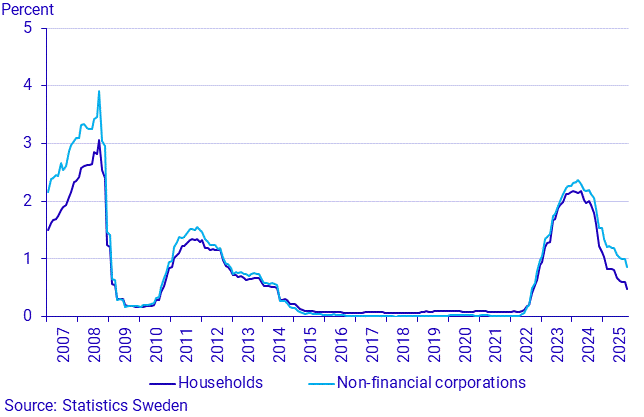
- Households’ average interest rate on new bank deposits decreased from 0.59 percent in September 2025 to 0.47 percent in October. This can also be compared with 1.60 percent for the same indicator in October 2024. The interest rate on accounts with fixed periods or a limited number of free withdrawals was 1.20 percent in October 2025, compared to 2.62 percent in October 2024.
- Non-financial corporations’ average interest rate for new bank deposits was 0.85 percent in October 2025. The interest rate on accounts with fixed periods or a limited number of free withdrawals was 1.60 percent for the same period.
About the statistics
The financial market statistics cover mainly monetary financial institutions (MFIs), but also include new institutes on mortgage markets, known as mortgage credit companies. Unless otherwise stated, the statistical news refers to MFIs.
The statistics include balance sheet statistics (including lending and deposits), interest rates, and monetary aggregates.
Definitions and explanations
The financial market statistics are compiled monthly. Revisions of the statistics may occur.
Monetary financial institutions (MFIs) comprise banks, housing credit institutions, finance companies, institutions financing municipalities and companies, monetary securities companies and monetary investment funds (money market funds).
Mortgage credit companies refers to non-MFI institutions that have authorisation from Finansinspektionen to issue mortgages. Usually, mortgage credit companies sell the mortgages to alternative investment funds (AIFs). The AIFs included in the financial markets statistics are linked to mortgage credit companies, and whose assets mainly comprise mortgages.
Growth rates are calculated to illustrate the development of transactions as from the corresponding period the previous year. The rates are calculated based on changes in stocks; adjustments are made so that the growth rate is not affected by stock changes unrelated to transactions.
Lending to households is divided into three categories: housing loans, consumer credit, and other lending. The purpose of a loan is not directly measured, but is approximated by categorising lending by type of collateral. Housing loans are defined as loans to private individuals or entrepreneurial households with housing as collateral. Consumer credit refers to lending to private individuals, generally without collateral. Other lending includes all other lending, for example lending to non-profit institutions serving households.
New agreements refer to agreements concluded during a given month. Interest rate statistics on new agreements is a way of measuring the price formation on loans and deposits in a given period. These statistics include all financial agreements in which the terms and conditions affecting the interest rates on deposits and lending are determined for the first time. The statistics also include renegotiations of existing loans and relocation of loans. Changes in floating interest rates due to automatic adjustments are not considered new agreements.
The loan-to-value ratio for all households is based on a sample survey. The statistics for loan-to-value ratios are derived from the MFI institutions included in the sample survey for the interest rate statistics. As of March 2025, the upper limit is included in the semi-open interval, for more information see notes.
Next publishing will be
The next item of statistical news in this series is scheduled for publication on 2025-12-30.
Statistical Database
More information is available in the Statistical Database
Feel free to use the facts from this statistical news but remember to state Source: Statistics Sweden.