
Labour Force Surveys (LFS) 2025:3 - Theme
More people wanted to change jobs during the high inflation
Statistical news from Statistics Sweden 2025-12-16 8.00
When the inflation was high in 2022–2023, more women entered the labour force and full-time employed men wanted to work more hours. Permanent employees also looked for and switched jobs during the high inflation. A new report from Statistics Sweden’s Labour Force Surveys (LFS) shows how the labour supply was affected in terms of labour force participation, desired working hours and employees seeking new employment.
– We observe changes in the labour supply during the high inflation period, both in terms of increased labour force participation and among employed people. More people wanted to work more hours and searched for other jobs, says Charlotta Olofsson, statistician at Statistics Sweden’s Labour Force Surveys.
This report analyses statistics from the Labour Force Surveys (LFS) with respect to the labour supply, focusing on the period of high inflation in Sweden in 2022–2023. The reported statistics highlight changes in labour force participation, desired working hours, as well as employees seeking new employment and switching jobs.
Historical decline in real wages
When inflation rapidly rose in 2022, real earnings saw a sharp decline and household expectations about the overall and personal financial situation fell to a level far below what we have seen previously. The high inflation lasted also during 2023, when the economy entered a recession. Labour demand decreased at the same time as more people tried to compensate for their household’s lower purchasing power by searching for jobs, working more hours or trying to switch job.
Significantly reduced purchasing power for Swedish households during 2022 and 2023.
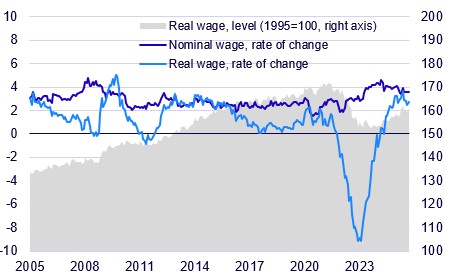
High inflation particularly affects households with lower income, since they consume a larger share of their income and have fewer opportunities to manage household finances by reducing consumption or by purchasing cheaper goods. Lower incomes are to a greater extent found among young people, people with lower levels of education, part-time employees, foreign-born, and in households where neither or only one partner is employed. In addition, households in different income groups with large housing loans are greatly impacted by interest rate hikes aimed at curbing inflation. After a period of high inflation, salaries also take time to adjust and the financial situation among the households with lowest incomes are still weaker than during the financial crisis.
Women entered the labour force and men wanted to work more
During the high inflation, labour force participation increased among women, and especially among foreign-born women. As the labour force participation rate is lower in this group, they also have a greater potential to contribute to the labour force through increased participation.
The possibility of adjusting working hours or changing from part-time to full-time employment is limited due to labour demand. In addition to actual and usually worked hours, the LFS also asks questions about the desired working hours. During the inflationary years 2022-2023, more full-time employed individuals wanted to increase their working hours, particularly among men. For part-time employees, it is more difficult to observe changes related to the period of high inflation, as the amount of underemployed in this group is strongly influenced by the economic situation and labour demand.
More people wanted to change jobs during the high inflation
The share of job seekers and actual job changes among permanent employees also increased in 2022 when inflation was high. As the economic situation slowed down in 2023, the share of job changes decreased, while the share of job seekers rose further. The increased use of AI has further simplified job search, particularly among employed people.
More people changed jobs during the inflationary years, but fewer in the following years.
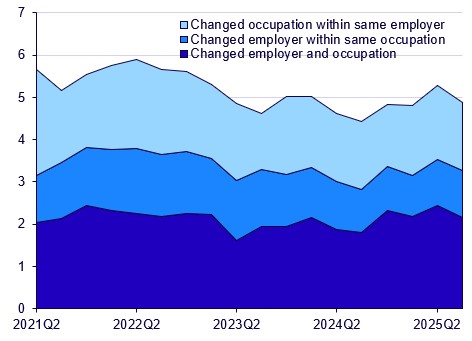
The most pronounced effect on the labour supply of native-born individuals was the rise in internal mobility among those already employed. The development of employed job seekers followed the unemployment trend observed among the younger individuals. One interpretation for this, is that the high proportion of employed job seekers can make it more difficult for new graduates to enter due to crowding-out effects. The proportion of employed job seekers increased further in 2025, especially among post-secondary graduates. This may reflect the fact that recent graduates had to take jobs that did not match their qualifications or educational orientation and continue their job search as employed.
Definitions and explanations
Desired working hours express how many hours per week a person would like to work (with a corresponding change in salary) and are related to the total time usually worked.
Job seekers are defined as permanently employed persons who have actively sought other work or extra work during the last four weeks.
Job change is defined in the report as the number or proportion of respondents who change employers for their main job, or who change occupational code according to SSYK 2012 at a detailed level from one quarter to another, among the permanent employees who remain employed.
A more detailed report on the labour market situation is available in the publication Labour Force Surveys (LFS) 2025:3 - Theme: Labour Supply and Job Change During the Inflation Period 2022–2023