
2024
Unequal incomes for employed women and men with disabilities
Statistical news from Statistics Sweden 2026-09-24 8.00
Women and men with disabilities make up just over one in ten of the working-age population, and about half were employed in 2024. Employed people with disability had lower net incomes compared to employed people in the rest of the population. Women with disabilities had the lowest net income among the employed.
Net income, also called disposable income, is the amount of income an individual has left to spend after taxes and other negative transfers. Among the entire employed population aged 16–64, women’s share of men’s net income was 86 percent, and this pattern was also present among persons with disabilities. Women’s share of men’s net income was 86 percent for persons without reduced work capacity and 92 per cent för persons with a reduced work capacity.
- The difference in net income between employed women and men in the population was also present among women and men with disabilities. Given that employed persons with disabilities have lower net income than the rest of the population means that women with disabilities are one of the groups with the lowest disposable income among employed, says Maria Larsson, Statistician at Statistics Sweden (SCB)
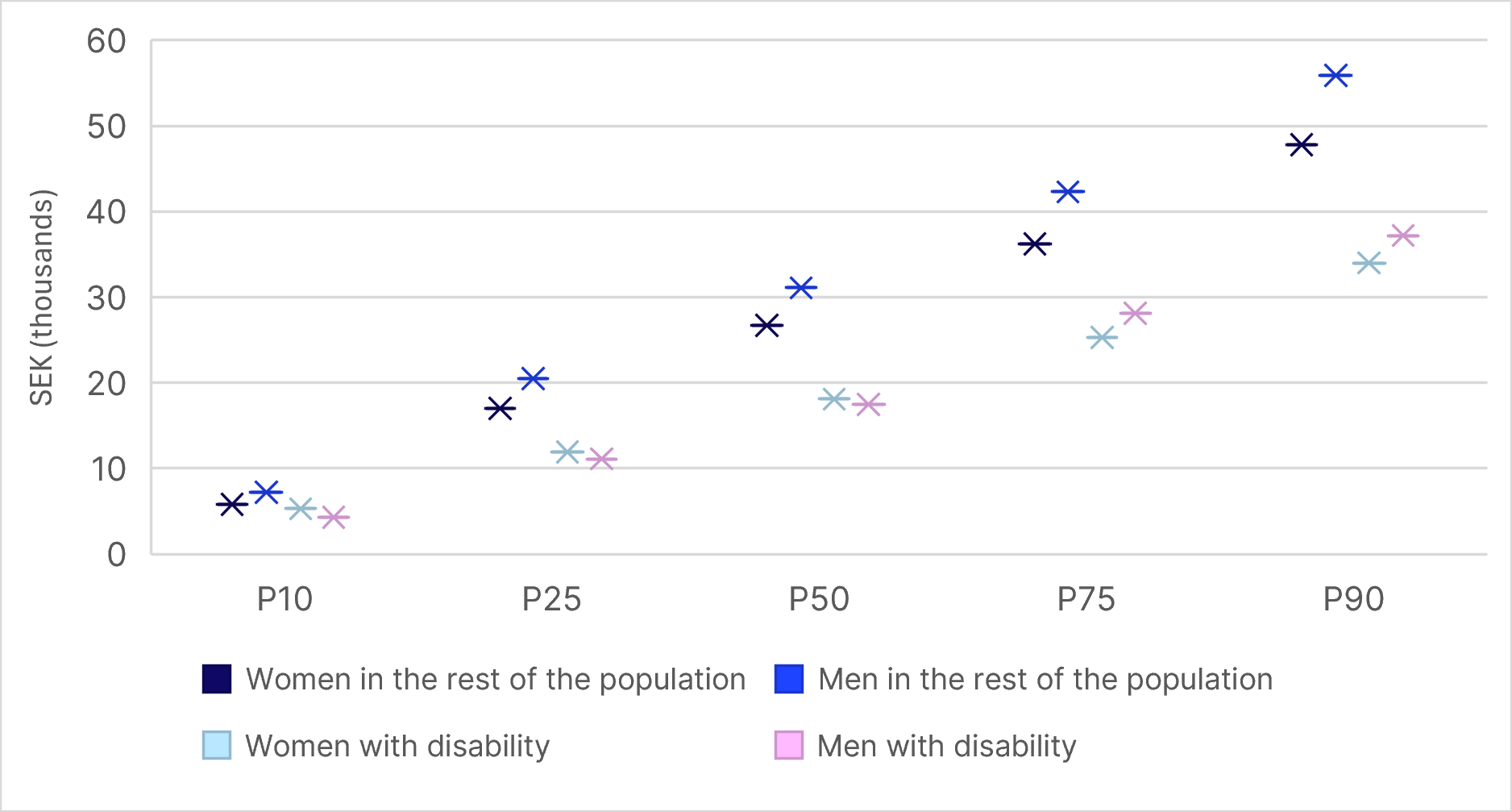
Employed women with disabilities had 5 600 SEK lower net income (median) per month compared to employed women in the rest of the population.
Lowest net income for employed women with disabilities
Looking at the whole group of people with disabilities, it was mainly in the upper part of the income distribution that differences in work income and earned income between women and men with disabilities appeared. The same pattern was seen for net income but the differences were not statistically significant.
Difference in net income between women and men with disabilities is evident in the upper part of the income distribution
No differences in net income between non employed women and men with disabilities
Net income did not differ between unemployed women and men, with disabilities, or among those outside the labour market. There were also no statistically significant differences in the rest of the population. A possible explanation is a levelling effect of the welfare system, such as income from sickness benefits and student grants.
One in four persons with disabilities are living with a low economic standard
Low economic standard is an at-risk-of poverty measure which means that the individual has a net income below 60 per cent of the national median equivalised disposable income. The low income standard is an absolute measure that indicates how much money a family has left after taxes and fees have been paid and any benefits have been received, relative to standardised estimates of the family’s necessary living costs, such as food, housing, home insurance and childcare.
- A quarter of persons with disabilities were living with low economic status, meaning they were at risk of poverty. Six percent of persons with disabilities, or approximately 50 000 persons, belonged to households with low income standard which means that the household cannot pay for what counts as necessary living expenses, says Matilda Wedtström Kjerfh, Statistician at Statistics Sweden (SCB).
A higher share of persons with low economic standard and low income standard, among persons with disabilities
| Low economic standard | Women | Men | Total |
| Persons with disabilities | 22,0 (3,0) | 27,4 (3,3) | 24,6 (2,2) |
| The rest of the population | 11,3 (0,8) | 9,7 (0,7) | 10,5 (0,5) |
| Low income standard | |||
| Persons with disabilities | 5,7 (1,6) | 7,2 (1,9) | 6,4 (1,3) |
| The rest of the population | 3,6 (0,5) | 3,2 (0,4) | 3,4 (0,3) |
Definitions and explanations
In this publication, the survey The labour market situation for persons with disabilities 2024 has been used together with the Income and Taxation Register 2024.
Persons with disabilities includes those who answered “Yes” to the question: “Do you have a disability? It can for example be a physical, psychological, cognitive, intellectual or neuropsychiatric disability”.
Total earned income is an individual income measure, meaning that it refers to a person's own income. It consists of income from employment and income from self-employment, before tax. Income from employment is a broad income category that includes wages, pensions, and taxable benefits such as sickness benefit, sickness and activity compensation, parental benefit, unemployment benefit, and similar payments. However, tax-exempt benefits, such as student aid, social assistance, and child allowance, are not included. Income from capital is also excluded.
Net income (individual disposable income) refers to an individual's own disposable income and is termed net income in Statistics Sweden's statistics. It is calculated as the sum of all taxable and tax-free income and benefits, minus taxes and other negative transfers, such as repaid student loans and paid child maintenance.
Economic standard is used for individuals, but the income level is adjusted using information on the income and composition of the entire household, including both adults and children. Based on economic standard, the measure low economic standard is derived, which refers to having a disposable income per consumption unit that is below 60 percent of the national median.
Income standard (also referred to as household disposable income) is the sum of the entire household's income after taxes and negative transfers. It corresponds to individual net income but is aggregated at the household level. The measure of low income standard is an absolute poverty measure, in which the household's total income is compared with necessary living expenses, such as food, housing, childcare, and local transportation.
Comments
Percentiles describe the distribution of income within a group. They are obtained by ranking all individuals by income and dividing the population into 100 equally sized groups. For example, the 25th percentile (P25) is the income level below which 25 per cent of individuals fall, while 75 per cent have a higher income.