Labour Force Surveys (LFS) 2026:1 - Theme
Unemployment in Sweden and in Europe
Statistical news from Statistics Sweden 2026-06-09 8.00
In 2025, unemployment in Sweden was at a higher level, both from a historical perspective and in comparison with many other countries. A new report from Statistics Sweden's Labour Force Surveys (LFS) describes unemployment in Sweden among people aged 15–74 years and compares it with other EU countries, Norway and Iceland.
- In Sweden, unemployment is higher among young people, foreign-born people and people with lower education. Many unemployed study full-time, especially young people. At the same time, unemployed full-time students are a heterogeneous group, from upper secondary school students to participants in the Swedish Public Employment Service's activities. Internationally, Sweden has a high unemployment rate but at the same time a lower proportion of long-term unemployed, says Eyvind Löfgren, statistician at the Labour Force Surveys at Statistics Sweden.
Higher unemployment among young people, foreign born people and people with lower education
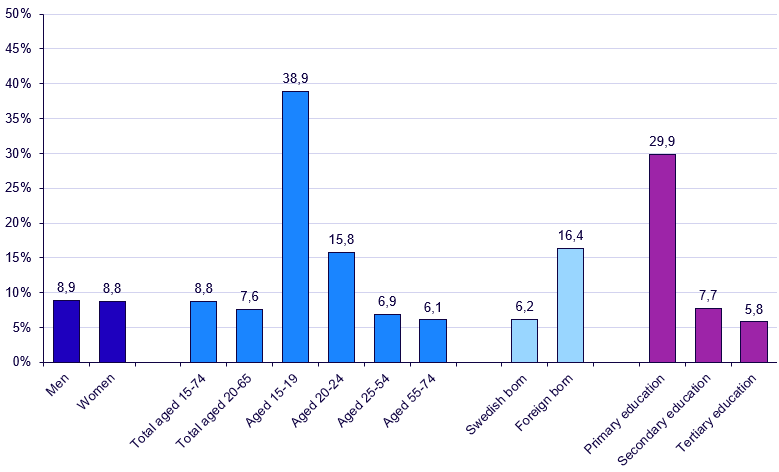
In 2025, 8.8 percent of the labour force, or 510 000 people aged 15–74 years, were unemployed in Sweden, which corresponds to one of the highest levels in 20 years. The unemployment rate among people aged 20–65 years, the age group that can be considered the core of the working-age population, was 7.6 percent. The proportion of unemployed decreased with increasing age and was significantly higher among people aged 15–19 years. Furthermore, the proportion of unemployed aged 15–74 years was higher among foreign born people and those with lower education. There were no noteworthy differences between the sexes.
Unemployment rate among people aged 15-74 years by sex, age, country of birth and educational attainment. Percent, 2025
Slightly more than one in three unemployed people were long-term unemployed
Among unemployed people aged 15–74 years, 36.0 percent were long-term unemployed. The corresponding proportion in the age group 20–65 years was 44.0 percent. The proportion of long-term unemployed increased with increasing age and was higher among foreign born people than Swedish born people.
Nearly two out of three unemployed wanted to work full-time
Most unemployed people wanted to work full-time, defined as 35 hours per week, or more. Among unemployed people aged 15–74 years 65.1 percent wanted to work at least full-time, and among those aged 20–65 years, the proportion was 76.1 percent. The proportion of unemployed people who wanted to work full-time or more was lower among women, young people and Swedish born people.
Unemployed full-time students are a large and heterogeneous group
People who study full-time are reported as unemployed if they, in the same way as the others, meet the criteria for being classified as unemployed. Among unemployed young people, many were full-time students and the number of unemployed full-time students increased ahead of the summer, when many are looking for summer jobs. However, unemployed full-time students constituted a heterogeneous group and consisted of both young and older people and included both people studying within the regular education system and people who participated in education, an initiative or an activity arranged by the Swedish Public Employment Service.
The report shows that when the youngest are excluded and the age group 20–65 years is studied, the group of unemployed full-time students was not completely different from unemployed people who did not study full-time. This was particularly true for unemployed people who participated in education, an initiative or an activity arranged by the Swedish Public Employment Service. There were similarities between unemployed people who studied full-time and unemployed people who did not study full-time in terms of, among other things, the proportion who were long-term unemployed and wanted to work at least full-time. Among unemployed people who participated in education, an initiative or an activity organised by the Swedish Public Employment Service, the proportion of long-term unemployed was even considerably higher than it was among unemployed people who were not studying full-time. Overall, 102 000 people in the age group 20–65 years were unemployed full-time students in 2025. Of these, 39 000 people were long-term unemployed, 63 000 people wanted to work full-time or more, and 41 000 people saw themselves primarily as job seekers.
Higher unemployment in Sweden compared to most EU countries
The report compares unemployment in Sweden with other EU countries, Norway and Iceland. In the absence of more up-to-date data, data from 2024 have been used for international comparisons. In terms of the age group 15–74 years, Sweden had one of the highest unemployment rates in the EU in 2024, after Spain and Greece. In Sweden, the unemployment rate was 8.4 percent, which was 2.5 percentage points higher than the EU average.
Unemployment rate aged 15-74 by age and country. Percent, 2024.
The unemployment rate in Sweden was 7.1 percent among people aged 20–64 years. For this age group, the unemployment rate instead ranks seventh in the EU. The unemployment rate among young people aged 15–24 years was 24.3 percent, which was the second highest in the EU. At the same time, Sweden had a significantly higher employment rate and labour force participation compared to the EU average, both among young people and for the entire population. In other words, the fact that a relatively larger share of the population in Sweden wanted to work contributed to both a higher employment and a higher unemployment.
Many young people and students among the unemployed in the Nordic countries
The report presents differences and similarities between countries in how unemployment is composed. In Sweden and the Nordic countries, young people and students make up a significantly larger share of total unemployment compared to the rest of the EU. In Sweden, young people made up 34.5 percent of the total number of unemployed, which was similar to the average of 35.6 percent for the Nordic countries. The corresponding proportion was lower in Southern and Eastern Europe, at 18.8 and 19.6 percent respectively. The share of studying young people among the unemployed varied the most. In Sweden, the proportion was 24.8 percent, and in the Nordic countries it was on average 25.2 percent. This compares with 4.3 percent in Southern Europe and 4.6 percent in Eastern Europe.
Young people do not only make up a larger share of unemployment in Sweden and the Nordic countries, but also a larger share among employed people compared to other countries in the EU. This indicates that young people, and the overlapping group of students, are generally more integrated into the labour market in Sweden and the Nordic countries. Among other findings, the report identifies a negative correlation between the average age at which young people leave the parental home and their labour force participation. In countries such as Sweden, Denmark and the Netherlands, where young people tend to move out earlier, youth labour force participation rates are among the highest. In contrast, in many southern and eastern European countries, young people remain in the parental home for longer, and labour force participation rates among young people are lower. The structure of a country’s education system can also influence labour force participation.
Lower share of long-term unemployed in Sweden compared to the EU
Among the unemployed in Sweden in 2024, 21.7 percent had been unemployed for 12 months or longer, which was lower than the EU countries' average of 32.6 percent. At the same time, Sweden recorded a higher level than Denmark, Norway and Iceland, where the corresponding share ranged between 12.2 and 15.8 percent. The proportion of long-term unemployed was highest in southern European countries, averaging 37.7 percent.
Definitions and explanations
Unemployed are people who did not work during the reference week, but who were actively looking for work during the last four weeks and were able to work during the reference week or start within 14 days of the end of the reference week. The unemployed also include people who found a job starting within three months, provided that they would have been able to work in the reference week or start within 14 days of the end of the reference week.
The report uses two different definitions of long-term unemployment. In the LFS, a person is classified as long-term unemployed after at least 27 weeks of unemployment. In international comparisons, however, the definition of at least one year's unemployment is used.
The national part of the report uses the term full-time students, while the international part uses the term students. The difference is that people who normally study full-time but are on summer holidays are not classified as full-time students in the national part but as students in the international part.
A more detailed report on the labour market situation is available in the publication Unemployment i Sweden
For inquiries about the national part, contact Felicia Holm or Daniel Samuelsson. For inquiries about the international part, contact Eyvind Löfgren or Sandra Medenica.