
2025-2026
Higer income in the first quarter compared to last year
Statistical news from Statistics Sweden 2026-06-16 8.00
Disposable income increased by 3.5 percent between March 2025 and March 2026. The rate of increase was higher for men than for women. Income rose the most in Boden, by 6.4 percent. By contrast, Skellefteå was the only municipality to experience a decline in income.
For the first time, Statistics Sweden (SCB) is now publishing individual-level statistics on monthly income, for the period January 2025–March 2026. The statistics are short-term and serve as a complement to the annual income statistics, which have a significantly longer production lag.
During January, February and March 2026, the median disposable income for the population aged 20 and older increased by 2.9 percent, 3.6 percent and 3.5 percent, respectively, compared with the same months in 2025. The figures have been adjusted for inflation using the Consumer Price Index (CPI).
At constant prices, income during the period studied was highest in September 2025 and January 2026.
- There is a certain seasonal pattern in income levels during the year, for example peaks at the start of the school terms when students receive student aid and in June when vacation pay is paid out, says Peter Gärdqvist at Statistics Sweden (SCB).
Median value for disposable income per month, at constant prices, SEK thousands. Population aged 20 and over
Men’s income increased the most
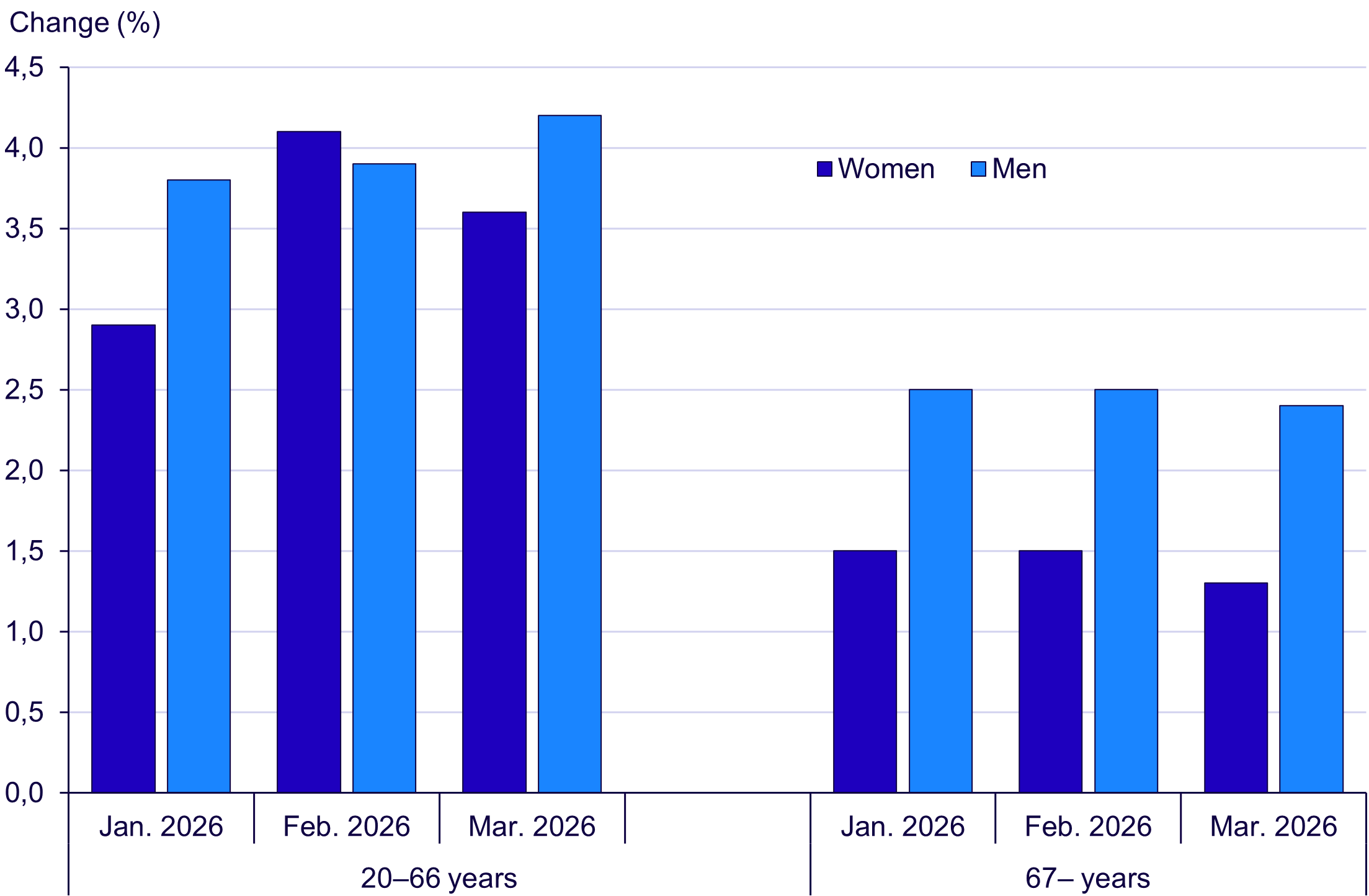
Men had higher disposable income than women in all measured months. Men also experienced stronger income growth during the first three months of the year compared with the same months in 2025 among those aged 20 and over. In February, however, women in working age (20–66 years) saw a larger percentage increase in income.
Among individuals aged 67 and over, for whom the majority of disposable income consists of pension income, the difference was largest. In this group, the growth for men was consistently one percentage point higher than for the women.
Percentage change in the median value of disposable income for January, February and March 2026 compared with the same months in 2025, at constant prices
Large variation between municipalities
As in the annual statistics, there are large differences between municipalities in income levels on a monthly basis. To a large extent, the same municipalities appear at the top and bottom when they are ranked by income. The same municipalities make up the top 5 for the median value in every month from January 2025 to March 2026: Danderyd, Täby, Lomma, Nacka and Lidingö.
Among the municipalities with the lowest incomes, the rankings vary between months, although the bottom position remains unchanged and is held by Högsby throughout the entire reported period. Other municipalities that frequently appear among those with the lowest monthly disposable income are Ljusnarsberg, Haparanda and Gullspång.
If we instead look at the percentage change over the latest twelve-month period, March 2025 to March 2026, income growth has been strongest in Boden, Askersund, Arjeplog and Gällivare, while Skellefteå, Perstorp and Gullspång have seen the weakest growth.
- Skellefteå is the only municipality to have experienced a decline in income, down 0.6 percent compared with March 2025. This is mainly due to closures in the battery manufacturing industry, says Peter Gärdqvist at SCB.
Municipalities with the highest and lowest growth in disposable income between March 2025 and March 2026. Percentage change in median values at constant prices. Population aged 20 and over
| Highest growth | Change (%) |
| Boden | 6,4 |
| Askersund | 5,6 |
| Arjeplog | 5,3 |
| Gällivare | 5,3 |
| Vadstena | 5,2 |
| Lowest growth | |
| Dals-Ed, Emmaboda and Haparanda | 1,7 |
| Hällefors | 1,5 |
| Gullspång | 0,8 |
| Perstorp | 0,7 |
| Skellefteå | -0,6 |
Definitions and explanations
Monthly disposable income: The income concept used in the statistics is individual disposable income excluding capital income. Disposable income refers to the sum of an individual’s taxable and tax-free income minus taxes and other negative transfers. Capital income is not included in disposable income in the monthly statistics.
Certain income components are missing from the administrative monthly registers. These incomes have instead been estimated at the individual level using models and subsequently included in the calculation of monthly disposable income.
Constant prices: All income amounts have been converted to the price level for March 2026 using the Consumer Price Index (CPI). In this way, the figures are adjusted for inflation.
Median value: The middle value in a group when all individuals are ranked by income.