
second quarter 2026
Household incomes continue to rise
Statistical news from Statistics Sweden 2026-10-01 8.00
Disposable income increased by 3.9 percent between June 2025 and June 2026. The rate of increase was highest among men of working age during the second quarter, while women aged 67 and older had the lowest rate of increase.
The household disposable income continued to rise during the second quarter, at a higher rate than during the first quarter. The inflation adjusted median income in April rose by 4.9 percent, compared with the same month in 2025, for the population 20 years and older. In May and June, the increase was 3.7 and 3.9 percent, respectively.
At constant prices, income during the period analysed from January 2025 to June 2026 was highest in the final month, SEK 25 900.
- Households' purchasing power reached its highest level in June 2026, considering the entire period from 2025 through the first half of 2026, says Daniel Kruse at Statistics Sweden (SCB).
Median value for disposable income per month, at constant prices, SEK thousands. Population aged 20 and over
Men’s income increased the most
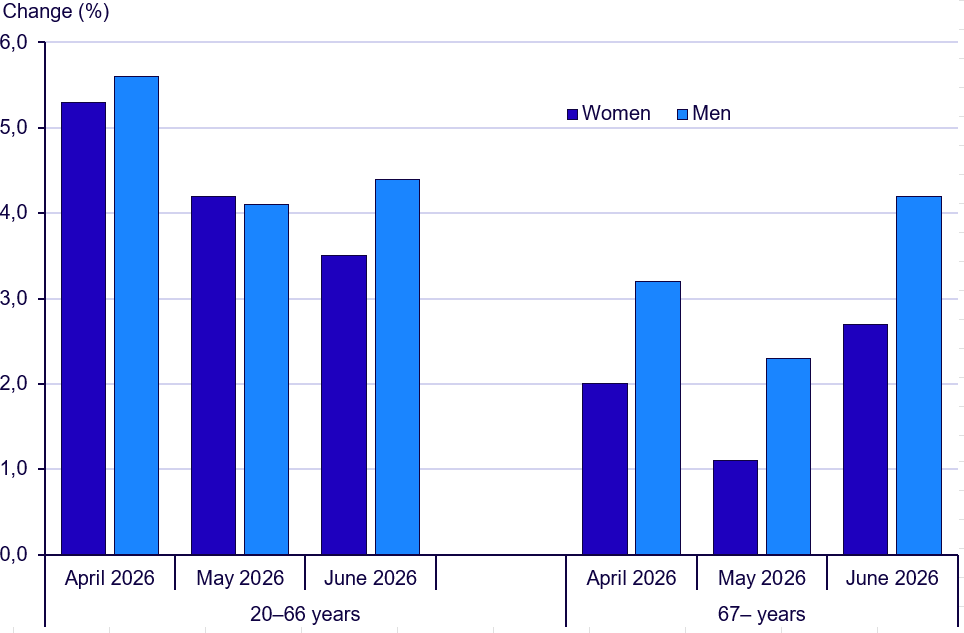
As during the first quarter, men experienced stronger income growth than women, compared to the same period last year. The growth rate for men of working age was 4.4 percent in June, compared to 3.5 for women. In May, however, the growth rate was slightly higher for women than for men.
The same pattern was observed among individuals aged 67 and over, where men’s disposable income increased by 4.2 percent in June, while the increase for women in the same age group was 2.7 percent. Overall, the higher rate of increase for men means that the gap in monthly income between men and women has widened.
Percentage change in the median value of disposable income for April, May and June 2026 compared with the same months in 2025, at constant prices
Largest increase in Norberg
In total, the median income rose by as much as or more than the national average of 3.9 percent in 182 municipalities. The largest increase occurred in Norberg (7.3 percent) and Laxå (6.7 percent), while Tranemo and Munkfors experienced the slowest growth, at 1.1 and 1.3 percent, respectively.
Skellefteå was the only municipality to experience a decline in income during the second quarter, with income falling by 0.2 percent in May compared with the same month last year. Income in Skellefteå also declined in January and March.
Municipalities with the highest and lowest growth in disposable income between June 2025 and June 2026. Percentage change in median values at constant prices. Population aged 20 and over
| Highest growth | Change (%) |
| Norberg | 7.3 |
| Laxå | 6.7 |
| Karlsborg | 6.5 |
| Degerfors | 6.5 |
| Hörby | 6.4 |
| Lowest growth | |
| Pajala | 2.3 |
| Vännäs | 2.1 |
| Lund | 1.9 |
| Munkfors | 1.3 |
| Tranemo | 1.1 |
Definitions and explanations
Monthly disposable income: The income concept used in the statistics is individual disposable income excluding capital income. Disposable income refers to the sum of an individual’s taxable and tax-free income minus taxes and other negative transfers. Capital income is not included in disposable income in the monthly statistics.
Certain income components are missing from the administrative monthly registers. These incomes have instead been estimated at the individual level using models and subsequently included in the calculation of monthly disposable income.
Constant prices: All income amounts have been converted to the price level for June 2026 using the Consumer Price Index (CPI). In this way, the figures are adjusted for inflation.
Median value: The middle value in a group when all individuals are ranked by income.