

Demographic analysis: Four generations and their demographic events
Four generations and their life events
Statistical news from Statistics Sweden 2025-12-17 8.00
A new report from Statistics Sweden follows people born in Sweden in 1975, 1985, 1995, and 2005 from birth to the year 2023, when they were 48, 38, 28, and 18 years old, respectively. The report compares, among other things, their infant mortality rates, how common it is to have grandparents alive, and the type of municipality they lived in at different ages.
Fewer children die during their first year of life
Infant mortality has clearly decreased between the four birth cohorts. For children born in 1975, infant mortality during the first year of life was 9.8 per 1,000 live-born boys and 7.4 per 1,000 live-born girls. For children born in 2005, infant mortality was 2.5 per 1,000 boys and 2.3 per 1,000 girls.
– For boys born in 1975, it was almost four times as common to die during the first year of life compared to those born in 2005, says Fredrik Bood, demographer at SCB.
| Birth year | |||||
|---|---|---|---|---|---|
| 1975 | 1985 | 1995 | 2005 | ||
| Boys | 9.8 | 7.2 | 4.7 | 2.5 | |
| Girls | 7.4 | 6.3 | 3.6 | 2.3 | |
The number of deaths at young ages continues to decrease after the first year of life. 640 boys and 460 girls born in 1975 had died before the year they turned 8, in 1983. This can be compared to boys and girls born in 2005, where 200 boys and 160 girls had died before turning 8, in 2013. 790 boys and 540 girls born in 1975 had died before the year they turned 18, in 1993. This can be compared to boys and girls born in 2005, where 250 boys and 200 girls had died by 2023.
| Birth year | |||||
|---|---|---|---|---|---|
| 1975 | 1985 | 1995 | 2005 | ||
| 8 years | 640 | 450 | 300 | 190 | |
| 8 years - per 1,000 | 12 | 9 | 6 | 4 | |
| 18 yearsr | 790 | 550 | 380 | 250 | |
| 18 years - per 1,000 | 15 | 11 | 7 | 5 | |
| Birth year | |||||
|---|---|---|---|---|---|
| 1975 | 1985 | 1995 | 2005 | ||
| 8 years | 460 | 370 | 240 | 160 | |
| 8 years - per 1,000 | 9 | 8 | 5 | 3 | |
| 18 years | 540 | 440 | 300 | 200 | |
| 18 years - per 1,000 | 11 | 9 | 6 | 4 | |
Those born in 2005 have grandparents alive longer than those born in 1975
At age 18, 3 out of 10 people born in 2005 had all grandparents alive, while 2 out of 10 people born in 1975 did. The reason is that the remaining life expectancy has increased for both maternal and paternal grandparents.
With few exceptions, the trend shows that survival at different ages is higher in the youngest cohort. At age 18, survival has increased most for maternal and paternal grandfathers. Just over half, 54 percent, of those born in 1975 had their maternal grandfather alive at age 18, while 65 percent of those born in 2005 did – a difference of 11 percentage points. The corresponding figures for those who had their paternal grandfather alive at age 18 were 48 percent for those born in 1975 and 58 percent for those born in 2005.
More common among later generations to live in a metropolitan or metropolitan-adjacent municipality
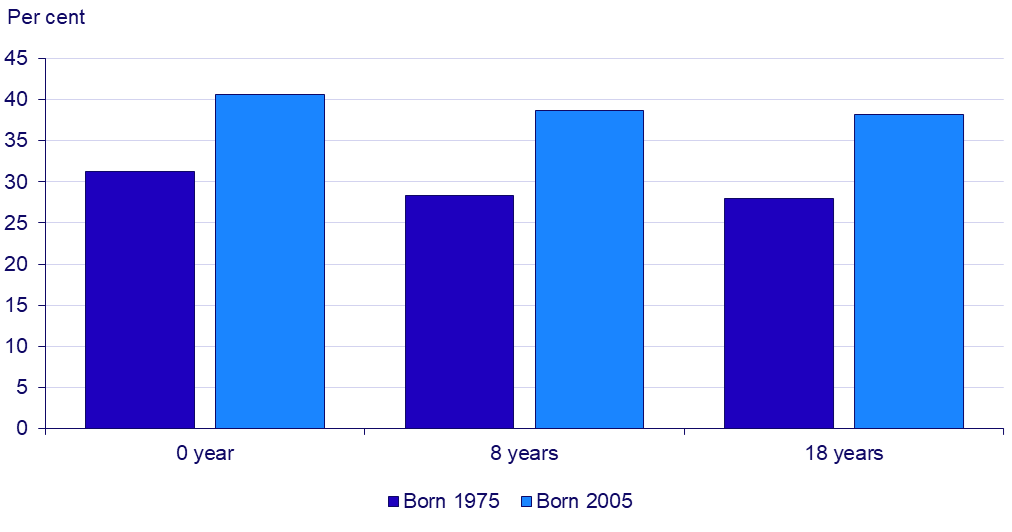
It is more common in the later generations, born in 1995 and 2005, to live in a metropolitan or metropolitan-adjacent municipality than in the earlier generations, born in 1975 and 1985. Almost 4 out of 10 people born in 2005 lived in a metropolitan or metropolitan-adjacent municipality the year they turned 18, in 2023. This can be compared to those born in 1975, where just under 3 out of 10 lived in such a municipality the year they turned 18, in 2013. This group includes municipalities such as Stockholm, Gothenburg, Malmö, Staffanstorp, and Kungsbacka.
Publication
Feel free to use the facts from this statistical news but remember to state Source: Statistics Sweden.