

Construction Cost Index for buildings, March 2018:
Construction costs rose by 2.6 percent on an annual basis
Statistical news from Statistics Sweden 2018-04-16 9.30
The Construction cost index for multi-dwelling buildings decreased by 0.1 percent between February and March 2018 and increased by 2.6 percent on an annual basis.
Developments over the last month
The Construction cost index decreased by 0.1 percent between February and March 2018. In the corresponding period in 2017, it remained unchanged. Contractors’ costs, which account for more than 82 percent of the Construction cost index, remained unchanged between February and March 2018.
Among contractors’ costs, building materials rose by 0.1 percent. In the group ‘building materials’, the cost of painting materials rose most among all materials. Wood products, woodwork, iron and steel and other building materials also rose between February and March. The cost of floor material, concrete and electric materials decreased, while white goods, plumbing material and reinforcement steel remained unchanged.
Costs in the group ‘transport, fuel and electricity’ decreased by 0.1 percent, in which the cost of fuel decreased, while costs of transport and electricity remained unchanged. Contractors’ other costs decreased by 0.3 percent, while machinery, wages and salaries remained unchanged.
Investor costs decreased by 0.3 percent between February and March 2018.
Developments over the past year
The Construction cost index increased by 2.6 percent and contractors’ costs rose by 2.7 percent between March 2017 and March 2018. The increased contractors’ costs resulted in an increase of 2.2 percentage points for the total index in the same period.
Building material costs increased most, 3.3 percent, among contractors’ costs. Contractors’ other costs, machinery, wages and salaries groups and the group of transport, fuel and electricity also increased. Reinforcement steel and iron and steel accounted for the largest price increase in the building materials group, and increased by 13.9 percent and 8.2 percent respectively. Costs in other building material groups also rose, except floor material, which decreased.
Investor costs increased by 2.1 percent on an annual basis.
Construction Cost Index for multi-dwelling buildings, excl. wage drift and value-added tax
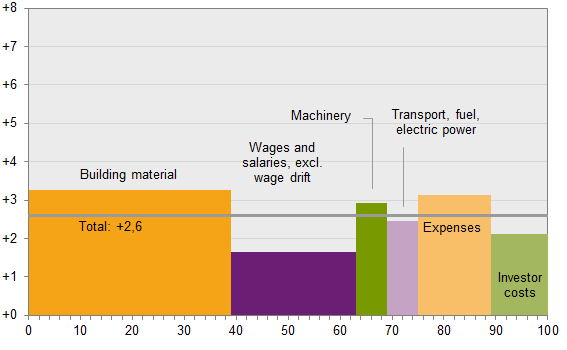
The width of the bars represents the production factor’s weight share in percent in the calculation of the Construction cost index for multi-dwelling buildings. The height of the bars represents the average price development for each product category.
| Goods | Change in percent | ||
|---|---|---|---|
| March 2017– March 2016 | March 2018– March 2017 | ||
|
Reinforcement steel
|
+19.9 | +13.9 | |
|
Iron and steel*
|
+10.4 | +8.2 | |
|
Material for painting
|
+0.2 | +5.6 | |
|
Wood products
|
+3.7 | +5.0 | |
|
Concrete products
|
+3.7 | +4.1 | |
|
Other building materials**
|
+4.2 | +3.2 | |
|
Plumbing material
|
+2.9 | +2.7 | |
|
White goods
|
+0.7 | +1.2 | |
|
Electric material
|
+2.2 | +1.1 | |
|
Woodwork
|
+3.6 | +1.0 | |
|
Floor material
|
+1.5 | -0.4 | |
|
Total building materials
|
+4.0 | +3.3 | |
* Includes reinforcement steel. ** Includes materials for thermal insulation, garbage equipment, gypsum and wood-based boards.
Construction Cost Index for multi-dwellings buildings, excl. VAT.
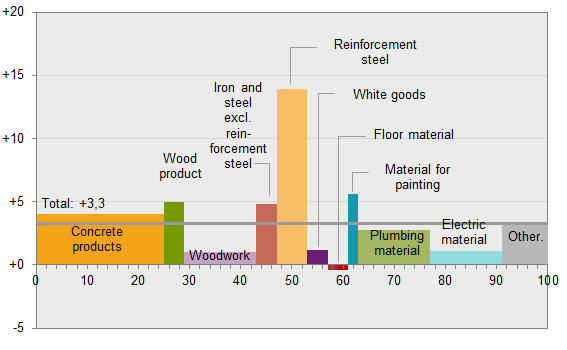
The width of the bars represents the production factor’s weight share in percent in the calculation of the Construction cost index for multi-dwelling buildings. The height of the bars represents the average price development for each product category.
Next publishing will be
2018-05-15 at 9:30.
Feel free to use the facts from this statistical news but remember to state Source: Statistics Sweden.